Track Profit, Not Revenue, in Google Ads
How do I track profit instead of revenue in Google Ads?
Add cart data to your conversion tag so each purchase lists its items, link the Merchant Center feed that carries your cost of goods sold, and Google Ads can report gross profit. Item IDs in the tag must match the feed exactly. Conversion value rules then adjust the value Smart Bidding sees by location, device or audience.
Google defines conversion value per cost as conversion value divided by cost. That is revenue over spend, and it says nothing about what the goods cost you. Illustratively, a store with a 40% gross margin needs a 2.5 return just to break even on product cost, so a 2.0 return loses money on every order. Google offers two ways to move the number closer to profit. Both are described in its help pages, read on 25 November 2026.
What does conversions with cart data add?
Google says conversions with cart data is an extension to conversion tracking on your website or app. It lets you provide the details of products sold for each transaction, to unlock advanced sales and profit reporting such as number of orders, average cart size, revenue and gross profit. You can see which items were bought after an ad interaction, analyse cross-sell patterns (reporting for cross-sell products is for Shopping ads only) and find products that lead to bigger baskets. Standard reports show that a purchase was made; cart reports show what the customer bought.
How does profit enter the picture?
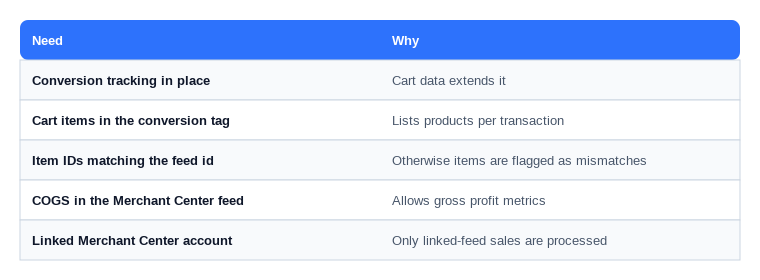
By combining cart data with the cost of goods sold (COGS) from your Merchant Center feed, Google says Google Ads can generate additional metrics based on gross profit. That means the feed needs a cost value for each product. Only sales of items from a Merchant Center ID linked to the Google Ads account are processed, so link the right account. See how to link Google Ads and Merchant Center.
| Need | Why |
|---|---|
| Conversion tracking in place | Cart data extends it |
| Cart items in the conversion tag | Lists products per transaction |
| Item IDs matching the feed id | Otherwise items are flagged as mismatches |
| COGS in the Merchant Center feed | Allows gross profit metrics |
| Linked Merchant Center account | Only linked-feed sales are processed |
What goes wrong with item IDs?
Google says item IDs passed in the items array of your conversion tag must exactly match the id attribute in your Merchant Center feed. If you see mismatches, download the flagged item IDs from the diagnostics section of your conversion action, compare them with product IDs in the linked Merchant Center account, adjust your website’s tagging to send the correct IDs, and make sure all sold items are present in the feed. A typical cause is a product ID in the tag against a variant ID in the feed, so check which one each uses.
If you use Google Analytics or Firebase key events, you can import them to view the cart data metrics; Google says you must link GA4 to your Google Ads account and turn on auto-tagging. See how to import GA4 conversions.
What are conversion value rules?
Google says conversion value rules let you adjust conversion value reporting and Smart Bidding optimisation, to express the value of conversions as they relate to your business, for example different margins for different users or lifetime value considerations. Rules adjust values by location, device and audience at auction time in real time. Google’s example: increase value for users in New York by 20%. The adjusted values show in the conversion value column and are used by Smart Bidding for Target ROAS and Maximize conversion value. Rules only apply to Search, Shopping, Display, Travel and Performance Max campaigns.
A store can use a rule for a real, measured difference in value, such as higher return rates on one device or higher repeat purchase on one audience. Do not invent adjustments; an unfounded rule teaches bidding the wrong thing.
How do I use this with a ROAS target?
Set targets from margin, not from revenue. The break-even ROAS calculator converts gross margin into the break-even return, and contribution margin explains why fees and returns lower it again. See also how to calculate margin ROAS from Shopify product costs.
What is a minimal profit measurement setup?
Start small. Add cost of goods sold for your top products in the Merchant Center feed, add cart data to the purchase tag for those products, link the accounts and wait for the reports. Check a few orders by hand: the items, the revenue and the cost should reconcile with your store. Then compare ROAS with gross-profit return for each campaign. You will often find that campaigns with the best revenue return are not the best profit return, because they push low-margin items. Use that finding to set margin tiers with custom labels and different targets. Do not forget costs outside the feed: payment fees, returns and shipping. Google’s gross profit uses the cost of goods you provide, so the rest still needs your own model.
Where does Bach.ai fit?
Bach.ai is our product. With a Shopify store connected it reads orders, products and, where available, product costs to show margin ROAS next to the platform’s revenue ROAS. On an active paid plan it can apply a supported Google Ads change after you approve it, by default. It does not install your conversion tag.
FAQ
Is gross profit reporting automatic?
No. Google says it needs cart data in your conversion tag and COGS in your Merchant Center feed, with the feed linked to the ad account.
Does cart data change bidding?
Google describes it as reporting and insight. Conversion value rules and value-based strategies are what change Smart Bidding’s inputs. Check what each setting does before assuming.
Why are my items flagged as mismatches?
Item IDs in the tag do not match the feed’s id attribute. Download the flagged list from conversion action diagnostics and correct the tagging.
Can I use conversion value rules for returns?
Only if you can measure the difference, such as a device with a persistently higher return rate. Google’s rules adjust by location, device and audience.
Sources
Sources, each opened and read on 25 Nov 2026: Google Help pages, About conversions with cart data; About conversion value rules; Conversion value per cost: Definition. Menu names and limits change, so check the page before you act.