How Consent Mode Works for Google Ads Stores
How does consent mode work for Google Ads?
Consent mode passes each visitor's cookie consent choice from your banner to Google tags, which then adjust how they behave. Basic mode loads no Google tag data before consent, advanced mode loads tags and sends consent signals. Google can model conversions only when you have implemented it correctly and have enough clicks per country and domain.
A cookie banner that blocks Google tags can make a store’s Google Ads conversions fall overnight. Consent mode is the mechanism Google provides to avoid a hard on or off: the banner passes the visitor’s choice to the tags, and the tags behave accordingly. It is also a policy matter for stores selling into Europe. This guide follows Google’s help pages, read on 25 November 2026.
What does consent mode do?
Google says consent mode lets you communicate your users’ cookie or app identifier consent status to Google, so tags adjust their behavior and respect users’ choices. It does not provide a consent banner or widget; rather it interacts with your banner to obtain visitor consent, and adapts how Analytics, Ads and third-party tags that create or read cookies behave. One signal worth knowing: ad_storage controls the use of Google Ads cookies and IDs, and if you don’t want Google Ads to use them you can set its default state to denied.
What is the difference between basic and advanced?
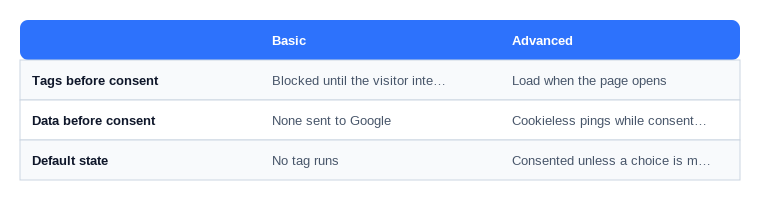
Google describes two ways to implement it. In basic consent mode you prevent Google tags from loading until a user interacts with a consent banner, so no data is transmitted to Google before the visitor responds. When consent is granted, tags load and send the consent states. In advanced mode Google tags load when a user opens the website or app, and while consent is denied they send cookieless pings. Google says the system defaults to a consented state unless a specific choice has been made, with regional behavioral differences for areas like the EEA, Switzerland and the UK, so check the default for your visitors.
| Basic | Advanced | |
|---|---|---|
| Tags before consent | Blocked until the visitor interacts | Load when the page opens |
| Data before consent | None sent to Google | Cookieless pings while consent is denied |
| Default state | No tag runs | Consented unless a choice is made, with regional differences |
Is it a requirement in Europe?
For the European Economic Area, Google says it is strengthening enforcement of its EU user consent policy. Advertisers must adhere to it to use ad personalization and for measurement with tags and SDKs that send data to Google. To keep using these for measurement, ad personalization and remarketing, you must collect consent for the use of personal data from end users based in the EEA and share consent signals with Google. The requirements also apply if you use Google Analytics data in Google Ads. Google also has a page on fixing issues with your EU User Consent Policy consent audit.
What is consent mode modeling?
When a visitor doesn’t consent, tags do not read or write advertising or analytics cookies, and you lose the link between ad interaction and conversion. Google’s modeling uses AI to estimate those conversions. It says modeled conversions appear in the Conversions column and in downstream reports. The thresholds are explicit: you must have correctly implemented consent mode or the IAB Transparency and Consent Framework, and you need a daily ad click threshold of 700 ad clicks over a 7-day period, per country and domain grouping. After that, models enter training periods, and you gradually see modeled conversions flow in.
How do I check my setup?
- Confirm your banner passes consent states, not just blocks scripts.
- Check the default consent state for your EEA, Swiss and UK visitors, since Google notes regional differences.
- Choose basic or advanced deliberately and document it.
- Test with a private window: accept and reject, then watch tags in the debug view.
- Compare Google Ads conversions with store orders before and after the change; see why Shopify orders and Google Ads conversions differ.
- Add enhanced conversions afterwards; see how to turn on enhanced conversions.
For the wider measurement gap, read how much of a platform’s ROAS is estimated rather than observed and the consent mode glossary entry.
What should a store without many clicks expect?
Google’s modeling threshold is 700 ad clicks over a 7-day period per country and domain grouping, so a small store may never qualify. In that case consent mode still respects visitors’ choices and keeps tags compliant, but you should not expect modeled conversions to fill the gap. Plan instead for a stable measurement baseline: compare Google Ads conversions with store orders weekly, note the typical ratio, and watch it for sudden changes rather than expecting it to match. Enhanced conversions can recover some attribution where consent allows. Do not weaken your banner to improve numbers; a lawful setup with a lower count is better than a high count you cannot defend.
Where does Bach.ai fit?
Bach.ai is our product. It reviews tracking and signal health on a connected Google Ads account and flags gaps that look like consent loss. It does not configure your consent banner or give legal advice, and on an active paid plan any supported Google Ads change waits for your approval, by default.
FAQ
Does consent mode replace my cookie banner?
No. Google says it provides no banner or widget; it works with the one you already have.
Will consent mode recover all lost conversions?
No. Modeling estimates part of the gap, only when thresholds are met, and shows in the Conversions column as modeled data. It is not a recovery of every lost order.
Is 700 clicks a daily figure?
Google states a daily ad click threshold of 700 ad clicks over a 7 day period, per country and domain grouping. Small stores may not reach it, which limits modeling.
Do I need legal advice?
This is documentation of Google’s policy, not legal advice. Check your own obligations with a qualified adviser.
Sources
Sources, each opened and read on 25 Nov 2026: Google Help pages, About consent mode; About consent mode modeling; Updates to consent mode for traffic in the EEA. Menu names and limits change, so check the page before you act.