Target CPA or Maximize Conversions in Google Ads?
Should I use Target CPA or Maximize conversions in Google Ads?
Use Maximize conversions when you want the most conversions the budget allows, and Target CPA when you need an average cost per conversion held near a number. Google says Target CPA can start with no conversion history and recommends judging results over at least 30 days and 30 conversions.
Both strategies are Smart Bidding, both chase conversions, and the difference is whether you give Google a cost target. Choosing wrong either starves a campaign or lets it overspend. This guide uses Google’s pages on Smart Bidding, automated bidding and Target CPA, fetched on 25 November 2026. Google is renaming strategies and changing its bidding systems in 2026, and notes that below, so check your own account’s labels.
What does each strategy do?
Google says Smart Bidding uses Google AI to optimize for conversions or conversion value in every auction, called auction-time bidding, and that Target CPA, Target ROAS, Maximize conversions and Maximize conversion value are all Smart Bidding strategies.
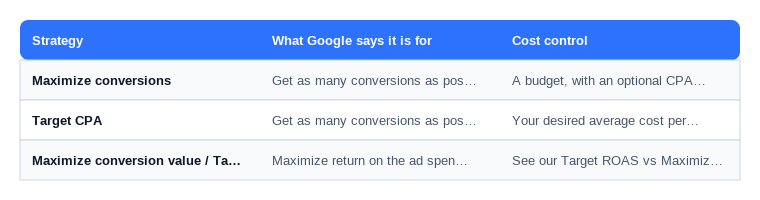
| Strategy | What Google says it is for | Cost control |
|---|---|---|
| Maximize conversions | Get as many conversions as possible within your budget | A budget, with an optional CPA target |
| Target CPA | Get as many conversions as possible while keeping average cost per conversion near the target you set | Your desired average cost per conversion |
| Maximize conversion value / Target ROAS | Maximize return on the ad spend you set | See our Target ROAS vs Maximize conversion value guide |
Google’s business-goal table puts Maximize conversions and Target CPA together under “Increase sales or leads” and Target ROAS and Maximize conversion value under “Increase profit”. For a store whose orders vary a lot in value, a value strategy is usually the better fit; see How do I track purchase value in Google Ads?.
How much data do I need?
Google says advertisers can start using Target CPA with no conversion history and that it is effective for campaigns of all sizes. For evaluating results, Google recommends measuring over longer periods with at least 30 conversions, such as a month or longer (50 conversions for Target ROAS). It adds that Smart Bidding can optimize on data from all your campaigns, so even new campaigns may notice improved performance, and that some strategies rely on a minimum volume of historical conversion data depending on the campaign type.
Google also tells you that some conversions will cost more than the target and some less, and that actual CPA depends on factors outside its control such as website changes, ads or competition. A target is a goal, not a ceiling.
What changed in 2026?
Two notices on Google’s pages matter. Starting June 2026, “Maximize conversions with a Target CPA” is renamed “Target CPA” and “Maximize conversion value with a Target ROAS” is renamed “Target ROAS”; Google says the underlying behavior is unchanged and no action is needed. And starting August 17, 2026, Google is updating its bidding systems for campaigns limited by budget, which may cause temporary performance and traffic fluctuations for campaigns using Target CPA or Target ROAS; Google points to a Bid Target Adjustment Tool for preparation. If a campaign changed behavior around that date, read that note before blaming creative or budget.
How do I choose?
- Count your last 30 days of conversions for the campaign; under about 30, start with Maximize conversions and no target.
- Set a break-even CPA: product margin per order minus other variable costs.
- If you have 30 or more conversions and a stable CPA, test Target CPA at a figure near your recent average, not your wish.
- Use Google’s Save as experiment option, where offered, to compare the new setting against the old one instead of switching blind.
- Judge after at least 30 days, as Google recommends.
- Review budget limits, since Google notes it may spend up to 2 times your average daily budget on a given day while not exceeding the monthly limit.
Remember to confirm that the conversions being optimised are real purchases; a miscounted conversion teaches the algorithm the wrong lesson. Our cause list for wrong counts is Why do Shopify and Google Ads conversions differ?. A campaign that does not spend at all is a different problem: Why is Google Ads not spending my budget?.
How do I run a clean test of the two strategies?
Do not switch a live winner blind. Google offers a Save as experiment option when you change a Target CPA setting, so you can compare new settings against the original. Use it, or duplicate the campaign with a split budget, and keep every other setting the same: assets, audience signals, products and conversion actions. Run both for at least a month, pick the winner on orders and margin from your store data, and write the result down. If the two campaigns share the same keywords or products they will compete in the same auctions, so exclude overlap first.
Bach.ai is our product. Its Google Ads audit reviews budget and bidding setup and flags spend on weak ad sets, ranking findings by estimated recoverable spend. On a paid plan a supported change is applied on Meta or Google Ads only after you approve it by default (Auto-Pilot is opt-in); the free trial does not apply changes, and recoverable-spend figures are estimates, not guarantees. For a hands-on review, use the Meta Ads audit checklist.
FAQ
Can a new campaign use Target CPA?
Google says advertisers can start using Target CPA with no conversion history. Expect more variance until volume builds.
How long should I wait before judging a bid change?
Google recommends measuring over at least 30 days with at least 30 conversions.
Does Target CPA cap my cost per order?
No. Google says some conversions cost more than the target and some less; it tries to keep the average near the target.
Are the names changing?
Google says that from June 2026 “Maximize conversions with a Target CPA” is shown as “Target CPA”, with behavior unchanged.
Sources, read on 25 November 2026: About Smart Bidding; About automated bidding; About target CPA bidding.