How Should I Structure Performance Max Asset Groups?
How should I structure Performance Max asset groups?
Create one asset group per theme or audience, such as a product category, and fill each with every asset type: text, images and video. Google's help page says to use the Ad Strength indicator, add as many assets as possible, and wait 2-3 weeks before replacing low performers.
A Performance Max campaign has no ad groups, so the asset group is where you shape what Google can show. Google’s help center defines it as a collection of creatives centered on a theme or related to a target audience, and says its assets are combined to build ads for Search, Maps, Display, YouTube, Gmail, Discover and partner sites. Everything below comes from Google’s asset group pages, fetched on 25 November 2026. Limits and menus change, so confirm on the linked pages.
What is Performance Max, in Google’s words?
Google’s overview calls Performance Max a goal-based campaign type that lets you access all Google Ads inventory, including YouTube, Display, Search, Discover, Gmail and Maps, from a single campaign. It says you can use it to complement keyword-based Search campaigns.
What exactly goes into an asset group?
Google says an asset provided in an asset group can be combined with any other asset from the same group to create ads. That one rule drives the structure: if two products need different messages, put them in different groups, because a headline written for one will be paired with the images of the other.
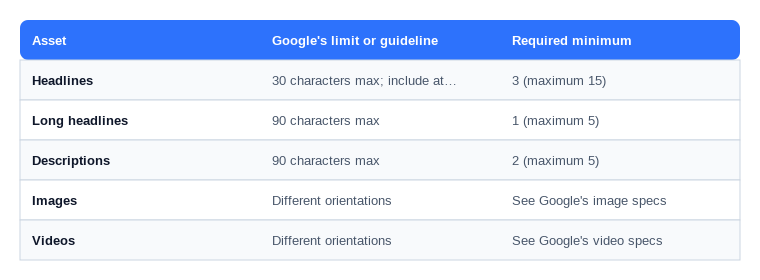
You can create multiple asset groups per campaign, either to group assets by theme or to group assets with different targeting. Google’s best-practice page gives the maximums it recommends filling: up to 15 headlines, 5 descriptions, 20 images in different orientations and 5 videos in different orientations.
| Asset | Google’s limit or guideline | Required minimum |
|---|---|---|
| Headlines | 30 characters max; include at least one of 15 characters or less | 3 (maximum 15) |
| Long headlines | 90 characters max | 1 (maximum 5) |
| Descriptions | 90 characters max | 2 (maximum 5) |
| Images | Different orientations | See Google’s image specs |
| Videos | Different orientations | See Google’s video specs |
How many asset groups should an online store make?
Google gives no number. Its guidance is to organise them around common themes or by your different products or services. For a store, the practical split is by product category or by margin tier, so that a high-margin line is not buried inside a campaign that mostly sells low-margin items. Start with the few categories that produce most of your revenue and add groups only when you have distinct creative for them.
- List your top categories by revenue from your store data, not from the ad platform.
- Create one asset group per category, each with its own headlines and images.
- Fill every asset type in every group: text, images and video.
- Check the Ad Strength indicator on each group and add assets until it stops flagging gaps.
- Wait before judging; see the timing section below.
If you connect a product feed, listing groups sit inside an asset group. Feed problems come first, so read Merchant Center product disapprovals: fixes before you restructure.
What does Google recommend for asset quality?
Google’s best-practice list says to use the Ad Strength indicator to see whether an asset group has enough assets, to cover all asset types in every group, to make sure assets meet quality guidelines, and to create variations to find the top performing creative. It also says to add as many assets as possible.
Google also notes that text customization, formerly called automatically created assets, is not available for Shopping ads. For other Performance Max ads, Google says it can use AI to generate additional headlines and descriptions from your landing page, domain and existing ads, and recommends keeping the setting on. You may prefer it off for regulated claims, so read the generated text before relying on it.
How long should I wait before changing assets?
Google says that after you edit assets, wait a few days for Ad Strength and asset group status to update, and wait 2-3 weeks before deciding to replace low-performing assets. That matters because many teams swap creative after a few days of noise. Meta has its own, different rules for edits and learning; see what resets the Meta learning phase if you run both channels.
Should I use Performance Max or Search for my store?
That depends on how much control you need over queries and how much feed and creative you have. We compare them in Performance Max vs Search campaigns for e-commerce. If Performance Max is already live and spending nothing, work through Why is Google Ads not spending my budget? first. For the bid side, see Target ROAS vs Maximize conversion value.
How does Bach.ai fit in?
Bach.ai is our product. Its audit reads Google Ads and Meta accounts, ranks findings by estimated recoverable spend, and on a paid plan can apply a supported change after you approve it by default; Auto-Pilot is opt-in, and the free trial does not apply changes. If you connect Shopify (from Starter) the connection is read-only and is used to compare ad-reported revenue with store orders. We do not promise any result from a restructure. Use the Meta Ads audit checklist as a model for the review.
FAQ
Can I put every product in one asset group?
You can, but Google says assets in a group are mixed freely, so one group means every headline can pair with every image. Separate by theme or audience, as Google recommends, when products need different messages.
What does the Ad Strength indicator tell me?
Google says to use it to determine whether an asset group has enough assets to drive best performance. It is a completeness signal, not a revenue forecast, so still judge groups by sales.
How long until I know if an asset works?
Google says to wait a few days for status updates and 2-3 weeks before replacing low performers. Decide by your sales data, not clicks alone.
Do I need video?
Google’s best-practice list says to cover all asset types, including video, in every group. Check Google’s current video requirements page for what happens if a group has none, since that is not covered in the pages we read.
Sources, read on 25 November 2026: Best practices for asset groups in Performance Max campaigns; How asset groups work; About Performance Max campaigns.