Is Performance Max Just Retargeting My Customers?
Is Performance Max just remarketing to existing customers?
Not by design: Google says Performance Max maximizes sales from both new and existing customers. To favour new buyers, use the new customer acquisition goal, which bids higher for new customers or bids only for them, and add brand exclusions so branded searches from existing customers do not take the credit.
Store owners often see strong Performance Max ROAS and suspect it is mostly capturing people who already knew the brand. Google’s own help pages address this and give two controls: the new customer acquisition goal and brand exclusions. This guide uses Google’s pages on Performance Max questions, customer lifecycle goals and the acquisition goal troubleshooter, fetched on 25 November 2026. Google’s menus and modes change, so check your account.
Is Performance Max remarketing?
Google says Performance Max campaigns can help you maximize total sales and revenue from both new and existing customers, and that engaging existing customers can be highly profitable because they already know your brand and often convert at a lower cost or higher order value. If your primary focus is new customers, it points to the new customer acquisition goal and to brand exclusions. So the campaign is not remarketing-only, but it will serve existing buyers unless you steer it.
What is the new customer acquisition goal?
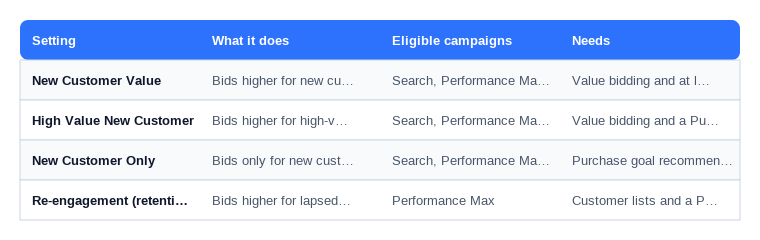
Google describes customer lifecycle goals as features that help you prioritise campaigns for stages of the customer lifecycle, in two categories: customer acquisition and customer retention.
| Setting | What it does | Eligible campaigns | Needs |
|---|---|---|---|
| New Customer Value | Bids higher for new customers than existing ones | Search, Performance Max, Shopping, Demand Gen | Value bidding and at least one Purchase conversion goal |
| High Value New Customer | Bids higher for high-value new customers | Search, Performance Max, Shopping | Value bidding and a Purchase goal |
| New Customer Only | Bids only for new customers | Search, Performance Max, Shopping, Demand Gen | Purchase goal recommended, not required |
| Re-engagement (retention) | Bids higher for lapsed customers | Performance Max | Customer lists and a Purchase goal |
Google’s troubleshooter says you can bid higher for new customers or bid for them exclusively. If you chose the exclusive mode and worry about performance, it recommends selecting “Bid higher for new customers (recommended)” instead, because that will not limit the campaign’s reach.
How do I turn it on?
- Configure new customer acquisition in your conversion settings, including the new customer parameter in the Google tag where used.
- Open the campaign’s Settings, expand Customer acquisition and tick the box to adjust bidding to help you gain new customers.
- Choose the mode: bid higher for new customers, or only bid for new customers.
- Provide customer lists where you use them, with multiple match keys such as email, phone number and zip code, as Google’s troubleshooter advises.
- Review after a full learning period before changing anything.
Why do I still see returning customers?
Google’s troubleshooter lists causes: in New Customer Value mode the value adjustment may not be high enough; in New Customer Only mode some traffic can still be returning when it was uncertain whether the customer was new at serving time, which Google says can be caused by technical limits such as Apple’s ITP and ATT policies; and a wrongly implemented tag can show many returning conversions. Its fix is to increase the new customer value adjustment and implement the recommended practices for accurate detection. Google also notes Performance Max and Search campaigns need one to two weeks to adjust to significant changes.
How do brand exclusions help?
Brand exclusions stop a campaign serving for branded queries, so the credit for brand searches moves to your Search campaign. Setup is in How do I stop Performance Max bidding on brand searches?. Whether the change helps depends on total store revenue, not on the campaign’s own ROAS, so reconcile with orders as in Shopify and Google Ads conversions differ: why.
Where does this fit with the rest of the account?
New customer value is a bidding setting, so it works with the strategies in Should I use Target ROAS or Maximize conversion value?. For account structure around the campaign see How should I structure Performance Max asset groups?, and for the Search side Performance Max vs Search campaigns for e-commerce. Your Meta retargeting overlaps too: Is your retargeting actually incremental?.
Bach.ai is our product. Its audit reviews Google Ads and Meta accounts and, with the read-only Shopify connection, checks reported revenue against real orders, which helps you see whether a campaign mostly captures existing customers. On a paid plan a supported change is applied on Meta or Google Ads only after you approve it by default (Auto-Pilot is opt-in); the free trial does not apply changes, and recoverable-spend figures are estimates, not guarantees. For a hands-on review, use the Meta Ads audit checklist.
FAQ
Does the new customer goal work on Search too?
Google’s lifecycle table lists Search, Performance Max, Shopping and Demand Gen as eligible for acquisition settings, with differences by mode.
Which mode should I pick?
Google recommends bidding higher for new customers over bidding only for them, since it does not limit the campaign’s reach.
How does Google know who is new?
Google’s pages mention Customer Match lists and the Google tag, and note limits from Apple’s privacy policies, so some uncertainty remains.
How long before I judge it?
Google notes Performance Max and Search campaigns need one to two weeks to adjust to significant changes, so allow at least that.
Sources, read on 25 November 2026: About customer lifecycle goals; Troubleshooting the new customer acquisition goal; Answering your top questions about Performance Max; Apply brand exclusions to Performance Max or Search campaigns.