Target ROAS vs Maximize Conversion Value? Pick One
Should I use Target ROAS or Maximize conversion value in Google Ads?
Use Maximize conversion value to spend the full budget for the most revenue when you have no firm return target. Use Target ROAS once you know your break-even ROAS and have at least 15 conversions in 30 days on Search or Shopping. Setting a target ROAS on Maximize conversion value makes it behave like Target ROAS.
Both strategies bid for conversion value, so they look alike in the settings screen. The difference is the instruction you give Google: “get me the most value for this budget” or “get me value at no worse than this return”. Choosing wrongly shows up as either a budget that is drained at a poor return or a campaign choked by a target it cannot reach. This guide shows what each does according to Google, the eligibility rules, and how to set the target from your own margin.
If your account is under-spending after a switch, read why Google Ads is not spending its budget alongside this.
What does each strategy do?
Google describes Maximize conversion value as a Smart Bidding strategy that helps you get the most conversion value from your budget. If you do not set a target ROAS, it tries to fully spend your average daily budget, so Google warns that switching from a campaign that spends much less than its budget could significantly increase spend (About Maximize conversion value bidding).
Target ROAS bids to maximize conversion value while trying to reach an average return on ad spend equal to your target. Google’s example: a target ROAS of 500% means $5 of sales for every $1 spent, calculated as $5 in sales divided by $1 in ad spend times 100% (About Target ROAS bidding).
The two meet in one place. Google states that a Maximize conversion value strategy with a target ROAS set behaves like a Target ROAS strategy.
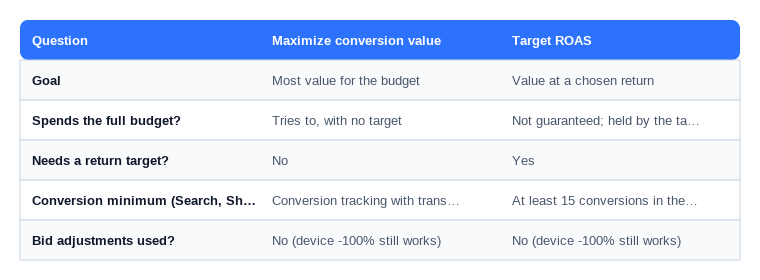
How do they compare?
| Question | Maximize conversion value | Target ROAS |
|---|---|---|
| Goal | Most value for the budget | Value at a chosen return |
| Spends the full budget? | Tries to, with no target | Not guaranteed; held by the target |
| Needs a return target? | No | Yes |
| Conversion minimum (Search, Shopping) | Conversion tracking with transaction values | At least 15 conversions in the past 30 days |
| Bid adjustments used? | No (device -100% still works) | No (device -100% still works) |
| Good fit | Budget-led scaling, early value data | You know the break-even ROAS |
Sources: Maximize conversion value and Target ROAS, read 24 Nov 2026. Google adds that from June 2026 it is relabelling strategies, so “Maximize conversion value with a Target ROAS” appears as “Target ROAS”; the bidding behaviour is unchanged.
What do you need before switching?
- Confirm conversion tracking sends a transaction-specific value. Both strategies need conversion values, not just counts.
- Check the minimum. For Search and Shopping, Target ROAS needs at least 15 conversions in the past 30 days at the conversion tracking level.
- If you recently started reporting conversion value or changed how it is reported, include the new values in the Conversions column and wait one to two conversion cycles before adopting either strategy.
- Review your budget. Google says to be comfortable spending up to 2 times your average daily budget on a given day, while over a month you will not be charged more than the average daily budget allowed over 30.4 days.
- In Google Ads, create or edit the strategy from the Bid strategies page, from campaign settings or while creating a campaign.
How do you choose the target from your margin?
A target ROAS that ignores margin is a guess. Start from break-even.
Break-even ROAS = 1 ÷ gross margin. Illustrative: a product with a 40% gross margin has a break-even ROAS of 1 ÷ 0.40 = 2.5, which is a target ROAS of 250%. Anything below 250% loses money on the product itself before shipping, fees and returns, so your real target sits above it.
Google itself notes that you define the value you maximize when you set up conversion tracking, such as sales revenue or profit margins. If you can feed profit instead of revenue into the conversion value, the same strategies optimize toward margin. The simpler route for most stores is to keep revenue as the value and set the target above the break-even figure. For the full cost stack, see how to compute break-even ROAS from true margin.
Google recommends a Target ROAS value after you create a strategy, calculated from your actual ROAS over the last few weeks, excluding the last few days to allow for delayed conversions. You can use it or set your own. Treat it as a starting point, not as your break-even.
When should you stay on Maximize conversion value?
Stay on Maximize conversion value while you are building history, while your margin differs sharply by product, or while you want volume and will cap return later. Move to Target ROAS when you have a firm break-even and want delivery held to it, accepting that a high target reduces volume.
One caution from Google’s documentation: starting 17 August 2026, Google updated how Target CPA and Target ROAS behave when a campaign is limited by budget, which can cause temporary traffic and performance fluctuations. If results moved after that date with no change from you, check the Google Ads help page on target-based bid strategy changes before editing the target.
What if Meta reports a different ROAS?
Google’s ROAS and Meta’s ROAS are measured by different systems with different attribution, so a target set in Google Ads is not comparable with the ROAS shown in Meta Ads Manager. Compare them through store revenue instead; why MER can tell a different story from platform ROAS explains the gap, and how to split budget between Meta and Google Ads uses it.
Where does Bach.ai help?
Bach.ai reads Meta accounts, and on Starter and above Google Ads too; where your Shopify product costs are available it shows margin ROAS beside platform ROAS, so a target can be checked against real profit. On a paid plan it can, by default, apply a supported bidding change only after you approve it (Auto-Pilot is opt-in). It does not guarantee a return; a recommendation with missing cost data is shown as inconclusive.
What to do next
Write down your break-even ROAS, confirm you have 15 or more conversions in 30 days, then pick one strategy and leave it for at least one to two conversion cycles. You can use the ad spend calculator to size the budget first.
FAQ
Is Target ROAS better than Maximize conversion value?
Neither is better outright. Target ROAS holds returns to a target and can limit volume. Maximize conversion value pursues volume of value within the budget. Choose by whether you have a trustworthy break-even figure.
How many conversions does Target ROAS need?
For Search and Shopping campaigns, Google requires at least 15 conversions in the past 30 days at the conversion tracking level. Other campaign types have different minimums listed on the Target ROAS help page.
Does Maximize conversion value use bid adjustments?
No. Google says the automated system bypasses active bid adjustments, with one exception: you can still set device bid adjustments of -100%. So bid adjustments will not steer this strategy, and device exclusion is the only adjustment you keep.
What target ROAS should I start with?
Start above your break-even ROAS. Google also suggests a value based on your actual ROAS over recent weeks. Use that as a reference, then adjust in steps. Because the target must clear your break-even, work that number out before you set anything, then move the target gradually.
Sources
Checked 24 Nov 2026: About Maximize conversion value bidding; About Target ROAS bidding.