Performance Max or Search for Ecommerce? 2026 Rules
Should an ecommerce store use Performance Max or Search campaigns?
Use both for most stores. Search gives keyword-level control and wins any query that hits an exact match keyword. Performance Max reaches YouTube, Display, Discover, Gmail, Maps and Search from one campaign, aimed at your conversion goal. Start Search on proven queries, then add Performance Max to find extra demand.
The choice between Performance Max and Search is usually framed as one or the other. Google’s documentation frames it as a division of labour: Search for the queries you name, Performance Max for the demand you did not think to name. For an ecommerce store the practical question is how much control you give up, what you can still see, and which campaign wins when both are eligible for the same query.
If you are still deciding whether Google belongs in your mix at all, start with whether an online store should use Facebook ads or Google ads. This guide assumes Google is already on the plan.
What does each campaign type actually do?
Google describes Performance Max as a goal-based campaign type that lets you reach all Google Ads inventory, including YouTube, Display, Search, Discover, Gmail and Maps, from a single campaign. You supply assets such as text, images, videos and a feed, plus a conversion goal and an optional ROAS or CPA target, and Google’s AI decides where to serve (About Performance Max campaigns).
Search campaigns serve text ads against queries that match keywords you choose. You decide the keyword, the match type and the negatives, and you can read the search terms report row by row (About the search terms report).
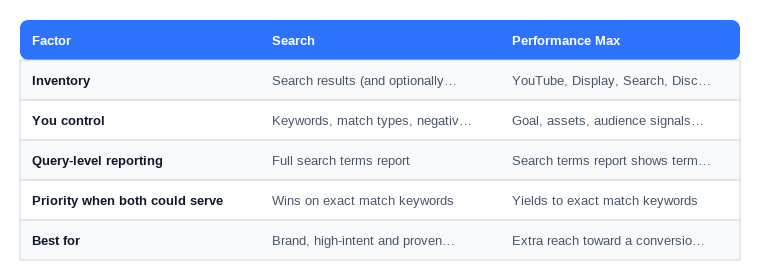
How do they compare for a store?
| Factor | Search | Performance Max |
|---|---|---|
| Inventory | Search results (and optionally search partners) | YouTube, Display, Search, Discover, Gmail, Maps |
| You control | Keywords, match types, negatives, ad copy | Goal, assets, audience signals, exclusions |
| Query-level reporting | Full search terms report | Search terms report shows terms that converted |
| Priority when both could serve | Wins on exact match keywords | Yields to exact match keywords |
| Best for | Brand, high-intent and proven queries | Extra reach toward a conversion goal |
Sources: Performance Max and search terms report, read 24 Nov 2026.
Which campaign wins when a query matches both?
Google states that Search campaigns containing an exact match keyword are prioritized over Performance Max when a query hits that exact match keyword. Search themes in Performance Max carry the same priority as phrase and broad match keywords. That gives you one dependable lever: put your most valuable exact-match queries, such as your brand name and your best-selling product terms, in Search, and Performance Max cannot take them over.
This is the answer to the common worry that Performance Max cannibalizes brand search. It can compete for broader queries, but an exact match keyword in Search takes precedence for that query.
What controls does Performance Max still give you?
Performance Max is not a black box with no switches. Google lists these campaign-level controls:
- Keywordless targeting, with optional search themes to steer Google toward the intent you want.
- Negative keywords and brand exclusions to block unwanted or overlapping queries.
- Final URL expansion, which lets Google send traffic to a more relevant landing page. Google notes you remain responsible for reviewing landing pages and generated assets.
- Channel prioritization, which sets priority tiers across inventory to guide how the budget is allocated, with optional daily budget allocations for search partners and the Display network.
- Budget recommendations at setup, with Low, Medium and High daily options.
How do you set up the two together?
- Build Search first on the queries you already know convert. In Google Ads, go to Campaigns, then New campaign, and choose the Sales goal with Search.
- Add exact match keywords for your brand and top products, so these queries stay in Search.
- Open the search terms report and add irrelevant queries as negatives. The search terms guide shows how.
- Create a Performance Max campaign with your product feed and your conversion goal. Add brand exclusions if you want brand traffic to stay in Search.
- Give each campaign its own budget at first, so you can read cost and return per campaign before merging anything.
- Review after at least one to two conversion cycles, not after two days. Google advises allowing that time after changes to bids and budgets.
A product feed is one of the inputs Google lists for Performance Max, so product data quality affects what it can show. If your products are disapproved in Merchant Center, they cannot serve; see how to fix Merchant Center disapprovals.
When is Search alone enough?
Search alone is enough when your catalog is small, your brand terms and a handful of product queries carry most of your revenue, and you need to prove returns query by query before adding broader reach. Performance Max alone is risky because you give up the exact-match protection that keeps your best queries in a campaign you can read.
Where does Bach.ai fit?
Bach.ai reads Google Ads accounts, including Performance Max and Search, ranks findings by estimated recoverable spend, and on a paid plan applies a supported change, by default, only after you approve it (Auto-Pilot is opt-in). It does not promise a ROAS outcome; it shows the evidence behind each finding, and an inconclusive finding says so. The Shopify connection is read-only and is used to compare what Google reports with real store orders.
What to do next
Run the Meta ads audit checklist beside your Google review, and keep your highest-intent queries in exact-match Search, run Performance Max beside it with its own budget, and compare the two against real store revenue rather than platform numbers alone. Bach.ai can read both campaign types in one place; Google Ads connections are included in the 7-day trial and from Starter (pricing).
FAQ
Is Performance Max better than Search for ecommerce?
Neither is better in general. Performance Max reaches more Google surfaces from one campaign, while Search gives query-level control. Google gives exact match Search keywords priority over Performance Max, so most stores run both.
Does Performance Max steal my brand traffic?
Not for exact match keywords. Google prioritizes a Search campaign with an exact match keyword when a query hits it. You can also add brand exclusions in Performance Max to keep brand queries out.
Can I see search terms in Performance Max?
Yes, in a limited form. Google says the search terms report in Performance Max helps identify the terms that resulted in conversions, which is narrower than the full Search report.
Do I need a Merchant Center feed for Performance Max?
For product ads you need a feed, and disapproved products do not show. Google lists a data feed among the inputs you combine with your goals and assets when setting up a campaign.
Sources
Checked 24 Nov 2026: About Performance Max campaigns; About the search terms report.