Google Demand Gen Best Practices for Stores
What are Google's best practices for Demand Gen conversions?
Google's Performance Four are data strength, conversion volume, AI targeting and creative variety, plus a consolidated structure. Advertisers who adopted at least three saw, on average, over 40 percent more conversions and 30 percent higher conversion value. Wait for 50 conversions and change bids and budgets by no more than 15 percent a week.
Google’s Demand Gen best-practice page, published as the YouTube Performance Four, is unusually specific: numbers for budget, change size, creative counts and ad group consolidation. It is Google’s own guidance and comes with Google’s own averages, so treat it as a checklist to test, not a guarantee. This guide summarises it, with sources read on 25 November 2026.
What are the four practices?
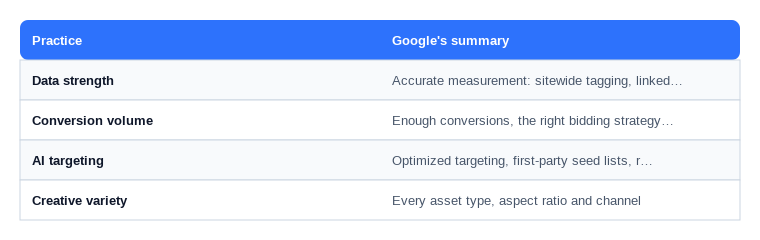
Google says advertisers who adopted at least three of four saw, on average, over 40% more conversions and 30% higher conversion value, with a footnote that this is Google data. The four:
| Practice | Google’s summary |
|---|---|
| Data strength | Accurate measurement: sitewide tagging, linked analytics, offline data with several identifiers |
| Conversion volume | Enough conversions, the right bidding strategy and budget |
| AI targeting | Optimized targeting, first-party seed lists, remarketing and new customer acquisition |
| Creative variety | Every asset type, aspect ratio and channel |
What does Google say about data?
Accurate measurement is the primary performance multiplier. It recommends sitewide tagging with the Google tag or Tag Manager, a Google Tag Gateway to serve tags from your own domain for more resilient signals, linked Google Analytics, and offline imports with at least three key identifiers such as GCLID, PII, IP, transaction ID or gbraid and wbraid. Because many YouTube conversions happen without a click, via engaged views, identity-based signals matter. For a store, start with the basics: conversion tracking setup and enhanced conversions.
What does Google say about volume and budget?
- Choose the strategy by goal: Target CPA or Target ROAS for a desired return; Maximize conversions or conversion value to spend the full budget; click strategies for clicks.
- Set a daily budget of $100 or more for Maximize strategies, and at least 10 times your target CPA for target strategies (Google’s figures in US dollars).
- Wait for 50 conversions: Google says to avoid evaluating performance until the campaign has generated at least 50 conversions.
- Apply the 15% rule: change bids and budgets slowly, by 5 to 10% and no more than 15% a week.
- Use shallow conversions for a faster ramp: if you optimise for purchases, map shallow actions such as page views or add to cart as non-biddable at account level so the system gets more data.
See the Demand Gen learning phase and value-based bidding requirements.
What about targeting?
Enable optimized targeting on prospecting campaigns and combine it with first-party seed lists, or if you cannot share lists, seed from high-performing audiences or custom segments; use remarketing for existing customers with tailored creative; and use the new customer acquisition goal to focus on people new to your business. See Demand Gen audiences.
How much creative variety?
Google’s benchmark is at least one ad in each Demand Gen campaign with 3 vertical, 3 square and 3 horizontal images and 1 vertical, 1 square and 1 horizontal video, with Shorts-only vertical video an option. Refresh by adding before replacing, changing assets gradually, keeping top performers and pausing only low performers that have had at least 14 days; test a big batch of new creative in a new campaign. Use the ABCD framework: attention, branding, connection, direction. See creative sizes and creative best practices.
How should I structure the campaign?
Google says the AI learns at campaign level, so consolidate similar audience themes, use a dedicated ad group for remarketing while keeping prospecting ad groups consolidated, and merge sparse ad groups: if an ad group has fewer than 30 conversions in 30 days, consider merging it with another. See account structure for Smart Bidding.
How do I test these?
Use a Demand Gen experiment. Google says experiments can test creatives, audiences, product feeds and bidding, recommends a 50% traffic split for the best comparison, supports up to 10 arms and does not recommend testing budget as a variable. Create new campaigns with the same start date, and note that A/B sync does not update budgets. Success metrics include click-through rate, conversion rate, cost per conversion and cost per click.
Which of the four should a small store do first?
Start with data strength, because everything else optimises against it: confirm purchases are recorded once with their value, enhanced conversions are on and consent handling works. Then conversion volume: pick a strategy that matches your goal and a budget that can reach about 50 conversions in a few weeks. If the budget cannot, reduce the number of ad groups and audiences rather than lowering your standards for evidence. Then creative variety: produce the nine images and three videos in Google’s benchmark in one afternoon, built from the same shoot. Last, structure: consolidate. Google’s own advice is to merge sparse ad groups, so a small account should end up with a few well-fed ad groups rather than many thin ones. Revisit the list each quarter, as Google’s guidance will change.
Where does Bach.ai fit?
Bach.ai is our product. It audits connected Google Ads accounts and, with your store connected, compares ad-reported conversions with real orders. On an active paid plan any supported change waits for your approval, by default.
FAQ
Are the 40 percent and 30 percent figures guaranteed?
No. They are Google’s averages for advertisers who adopted at least three of four practices.
What daily budget should I use?
Google’s guide says $100 or more for Maximize strategies and at least 10 times target CPA for target strategies, in US dollars.
How fast can I change bids?
Google says 5 to 10 percent a week and no more than 15 percent.
When can I judge results?
Google says not before the campaign has generated at least 50 conversions.
Sources
Sources, each opened and read on 25 Nov 2026: Google Help pages, Best practices for high performing Demand Gen campaigns; About Demand Gen performance during the learning phase; Create A/B experiments for Demand Gen campaigns. Menu names and limits change, so check the page before you act.