How Long Is the Demand Gen Learning Phase?
How long is the Demand Gen learning phase?
Google says calibration can take around 50 conversion events or 3 conversion cycles, though it can be faster with more data, and you should aim to reach them within 2 weeks. Avoid significant changes during it, expect swings in CTR and conversion rate, and read the Learning phase estimates card shown while you build the campaign.
The first week of a Demand Gen campaign is where most stores lose patience. CTR swings, conversions are lumpy and the temptation is to change everything. Google’s page on the learning phase is more specific than most platform guidance: it gives a data target and a timeframe. This guide uses it, with the other Demand Gen help pages, read on 25 November 2026.
What is the learning phase?
Google says the initial phase is critical for overall campaign success: the campaign or portfolio goes through a calibration process to align with the newly established goal. After you create a campaign or change bids, budgets or creatives, the campaign needs time to calibrate towards its goal, and a Learning status may appear in the bid strategy status. Google says the system, which relies on machine learning, needs a certain amount of data, and that the period can take up to around 50 conversion events or 3 conversion cycles for the bid strategy to calibrate, though it can be faster with more conversion data. It recommends aiming to achieve those conversions within 2 weeks.
What should I avoid?
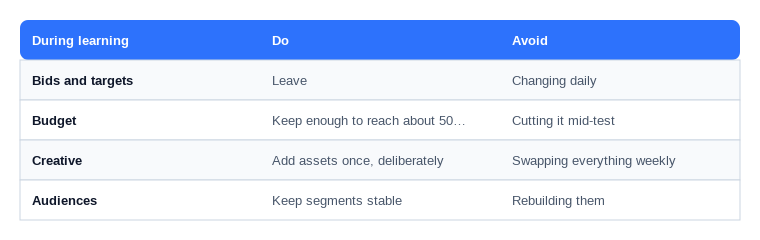
Google says to avoid making significant changes to campaign settings during the learning phase, because that can disrupt learning and delay optimal performance, and to follow the recommendations in the Google Ads interface. As the system learns, you may see fluctuations in metrics such as click-through rate and conversion rate; Google calls these natural, and says they should even out once performance stabilises.
| During learning | Do | Avoid |
|---|---|---|
| Bids and targets | Leave | Changing daily |
| Budget | Keep enough to reach about 50 conversions in 2 weeks | Cutting it mid-test |
| Creative | Add assets once, deliberately | Swapping everything weekly |
| Audiences | Keep segments stable | Rebuilding them |
Where do I see estimates?
While building a campaign, after you add a budget, a forecast card titled Learning phase estimates shows what to expect: days to first conversion, and expected conversions in the first week, among others. Use it before launch to check that the budget can reach about 50 conversions in two weeks. If it cannot, raise the budget, simplify the audience or choose a shallower conversion goal first.
How do I do the sums?
Illustratively, if your cost per purchase is $40, 50 conversions in 2 weeks need about $2,000 of spend, roughly $143 a day. With a $30 daily budget, calibration takes much longer. Compare this with your own numbers before deciding to run Demand Gen at all, or consider a higher-funnel goal such as add to cart while data builds, with the primary-action caveats in primary versus secondary conversions.
What if performance stays poor?
Google’s Demand Gen pages have separate troubleshooters for campaigns not running or with low traffic and for performance fluctuations. The not-running page says new campaigns generally take up to 24 hours (often under 12) to sync before impressions appear, and that Demand Gen maintains a stricter creative quality threshold than standard Video or Performance Max campaigns. The fluctuations page offers Explanations that compare the selected period with the previous one, and says that with view-through optimization enabled a campaign can use view-through signals as well, which can lead to faster ramp-up and fewer fluctuations. Check, in order, feed issues if you use one (Demand Gen product feeds), conversion tracking (enhanced conversions), creative quality (Demand Gen creative specs) and the target. Use an experiment rather than editing live: how to run a Google Ads experiment.
Is it different from the general Learning status?
Google’s general Smart Bidding Learning status never lasts more than 7 days; the Demand Gen page describes a longer calibration measured in conversions and conversion cycles. Both apply; see how long Learning status lasts.
What can I do to reach 50 conversions faster?
Learning speed depends on how often the chosen conversion happens. If purchases are too rare, choose a conversion that occurs more often and still correlates with sales, such as add to cart, as a temporary primary goal, and switch to purchase once volume allows. Consolidate budget into fewer campaigns and ad groups so each gets enough data; splitting a small budget across five audiences gives each too little. Keep the creative set stable during the window, and make sure tracking is accurate before launch, since a broken tag looks like a failed campaign. Use the Learning phase estimates card to compare budget options before saving. Finally, set expectations with whoever approves the budget: early results are calibration, and a decision after three days is a decision on noise.
Where does Bach.ai fit?
Bach.ai is our product. It reviews Google Ads campaigns and flags new campaigns that are likely to take long to calibrate because spend is low relative to cost per conversion. On an active paid plan it can apply a supported change after you approve it, by default. It cannot shorten Google’s learning.
FAQ
How many conversions does Demand Gen need?
Google says around 50 conversion events, or 3 conversion cycles, though it can be faster with more data.
Should I edit the campaign during learning?
Google says to avoid significant changes during the learning phase.
Why is CTR moving so much?
Google says fluctuations in metrics such as CTR and conversion rate are a natural part of learning and should even out.
Where is the estimate card?
During campaign construction, after you add a budget, as Learning phase estimates.
Sources
Sources, each opened and read on 25 Nov 2026: Google Help pages, About Demand Gen performance during the learning phase; Troubleshooting performance fluctuations in Demand Gen campaigns; Troubleshoot Demand Gen campaigns not running or low traffic. Menu names and limits change, so check the page before you act.