What Is Meta's Parameter Builder Library?
What is the Conversions API Parameter Builder Library?
It is a set of open-source Meta code libraries, for browsers and for several server languages, that generate and format the customer parameters sent with Conversions API events. It handles click and browser IDs, IP address, page URLs, and email or phone formatting, which can lift event match quality. A developer installs it.
Most weak Conversions API setups are not missing events. They are missing the small details that let Meta tie an event to a person: a click ID, a browser ID, an IP address, a properly formatted email. Meta publishes a free library that does this plumbing. You will not install it yourself, but you can ask whether your developer or platform uses it, and what to check if they do.
What is the Parameter Builder Library?
According to Meta’s Parameter Builder Library documentation, it is a list of open-source SDKs, meaning code kits, in two forms. The client-side version runs in the browser and is written in JavaScript. The server-side versions run on your backend and exist for PHP, Java, Python, Node.js and Ruby. Meta says the library can help you create, manage and send certain customer information parameters, which may lead to better event match quality (EMQ) scores.
Its four stated jobs are generating match keys according to Meta’s best practices, increasing coverage of important event parameters, formatting customer information such as email and phone correctly, and reducing the manual work and error risk of handling parameters yourself.
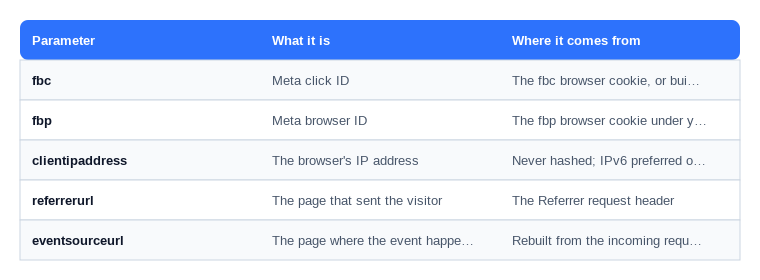
Which parameters does it handle?
| Parameter | What it is | Where it comes from |
|---|---|---|
| fbc | Meta click ID | The _fbc browser cookie, or built from the fbclid in the landing URL |
| fbp | Meta browser ID | The _fbp browser cookie under your domain |
| client_ip_address | The browser’s IP address | Never hashed; IPv6 preferred over IPv4 |
| referrer_url | The page that sent the visitor | The Referrer request header |
| event_source_url | The page where the event happened | Rebuilt from the incoming request |
| Customer details (email, phone, name, birth date, gender, city, state, zip, country, external ID) | Match keys about the customer; external ID is your own ID for a person, such as a loyalty membership ID | Normalized and hashed by the library |
Meta marks some support as “coming soon”: the IP address and the normalizing features are listed for JavaScript, PHP and Node.js, with Java, Python and Ruby following. Check the current page before promising a language to a client. For what each field means and why it matters, read what parameters every Conversions API event needs.
Why does this matter for match quality?
Meta describes event match quality as a score out of 10 built from which customer parameters you send, their quality and the share of events that match a Meta account. Its Dataset Quality documentation lists issues the diagnostics can flag: no client IP address, an IP belonging to a privacy relay, IPv4 sent where IPv6 would match better, too small a share of events with the fbc click ID, and many events sharing one placeholder email or phone. Those are the gaps this library is built to close. For the wider checklist, see how to improve event match quality.
How does the library format customer data?
For email, phone, names, birth date, gender, city, state, zip, country and external ID, Meta says the library adopts the best practice to normalize and hash the values, so no further action is needed. Its example turns “John_Smith@gmail.com” into the lowercase “john_smith@gmail.com” before hashing.
Two rules follow. First, normalize and hash only once, either on the client or on the server, before sending to Meta. Second, the values the library returns are case sensitive, so you can send them as they are without lowercasing them again. If you want the full manual rules, see how to hash and format customer data for the Conversions API.
Meta also adds an eight-character appendix to each parameter the library processes, which it uses to evaluate the library’s performance. It encodes the SDK version, incrementality and SDK language. If you see a two-character appendix, Meta says that is a legacy format and tells you to upgrade to the latest version.
What are Meta’s best practices for cookies and IP addresses?
Meta’s documentation gives specific rules a developer can verify:
- Save the _fbp and _fbc cookies as early as possible in the visit, ideally when the landing page loads, rather than only on events deep in the funnel.
- Do not override or adjust the cookie values. The _fbc value is case sensitive and must not be lowercased.
- When retrieving the IP address, try IPv6 first and fall back to IPv4.
- Use the client-side library to capture the IP address into a cookie, then let the server-side library choose the best available address from the cookie and the request.
- Apply the libraries across every surface and domain you track, including mobile and desktop browsers.
- On the server, new users should use the processRequestFromContext function, because Meta says the older processRequest is deprecated. The newer one retrieves richer data such as event_source_url.
How should you check that it is working?
- Ask your developer or platform vendor whether the client-side and server-side libraries are both installed, and which versions.
- Ask where the _fbp and _fbc cookies are first captured, and confirm it is the landing page.
- Confirm that email and phone are normalized and hashed once, not twice.
- Open Events Manager and compare EMQ and the match-key list before and after the change, using the diagnostics Events Manager shows for each event as the guide.
- Re-check after any site or checkout change, since a new page template can drop the cookie capture.
Where does Bach.ai fit?
Bach.ai is our product. It audits Meta and Google Ads accounts and checks tracking and signal health, including pixel, Conversions API, event coverage and deduplication; it does not install or configure the Parameter Builder Library, and findings are estimates, not guarantees. On a paid plan a supported change is applied only after you approve it by default. For a wider review, use the Meta ads audit checklist and the Meta Pixel and Conversions API hub.
FAQ
Is the Parameter Builder Library required?
Meta does not describe it as mandatory. It presents the library as something you can implement to improve the quality of a Conversions API integration. You can send the same parameters by hand, but then your team owns the formatting and cookie rules.
Does it replace the Conversions API Gateway?
They are different things. The Parameter Builder Library helps build parameters inside your own integration. The Gateway is a separate Meta product that you provision in your cloud account. Choose by who maintains the setup.
Does it hash the IP address?
No. Meta says the client IP address must never be hashed and must be a valid IPv4 or IPv6 address. Email, phone and the other customer details are normalized and hashed by the library, but the IP is sent as is.
Which languages does the server-side library support?
Meta lists PHP, Java, Python, Node.js and Ruby for the server side, and JavaScript for the browser. Support for individual parameters varies by language, so check the current documentation page.
Sources, read on 25 November 2026: Parameter Builder Library; Dataset Quality API; External ID.