What Is external_id in the Conversions API?
What is external_id in the Conversions API?
External ID is a string that identifies a person in your own system, such as a loyalty membership ID, a user ID or an external cookie ID. Send it with every Pixel and Conversions API event, keep it identical across channels, and Meta can match events to the same person. Hashing is recommended.
Of all the customer details you can send with an event, external_id is the one only you can supply, because it comes from your own system rather than from a form field. Used well, it lets Meta recognise the same person across the browser and the server. Used inconsistently, it adds noise. Here is what Meta’s documentation says it is, how it behaves, and what to check.
What is external_id?
Meta’s External ID documentation defines it as a string that represents a user on an advertiser’s system, such as loyalty membership IDs, user IDs and external cookie IDs. You can send one or more external IDs for an event, and Meta tries to match them to someone on Facebook. It accepts a single string or an array of strings, and Meta recommends hashing.
It can travel through several channels: the browser Pixel, the Conversions API and the Offline Conversions API. Meta’s key instruction is to be consistent across them. If a Pixel event for a visitor carries external_id 123, the Conversions API event for that same visitor should also carry 123.
Why would I send it?
Meta lists four benefits:
- Scale. Once you provide an external ID it can be reused across channels and audiences. You map it to your internal identity system and no longer need to manage a large number of personal identifiers.
- Better match rates across channels. A match found through one channel can help on a channel where you lack other identifiers.
- Your own audiences. External ID can feed audience creation, covered below.
- Security and privacy. Instead of uploading hashed personal data repeatedly, you can send the external ID with the personal data once and reuse that match.
How does Meta use an external ID?
Meta describes a three-step process. First, you send an event with an external_id plus other customer information. Second, Meta looks for a match using everything you sent, and if it finds one, it associates your external_id with that specific user. Third, in later events you can send only the external_id, and Meta keeps the earlier association.
Meta’s worked example: a visitor views a product and you send a ViewContent event through the Pixel with a hashed email and a hashed external ID. Meta matches on the email and remembers the link to your ID. A couple of days later the same person buys, and you send a Purchase through the Conversions API with just the external ID. Meta recognises the earlier match and reuses it.
One limit matters for planning: Meta says external_id matches expire periodically and recommends refreshing them as frequently as possible. Keep sending the ID, with other customer details, on new events rather than treating the first match as permanent.
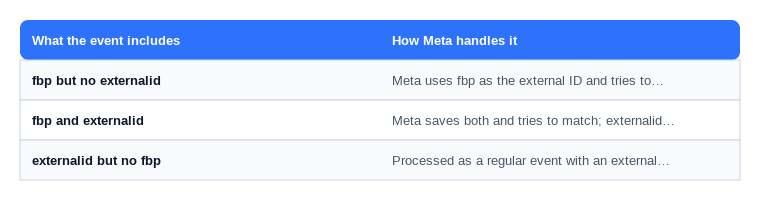
What happens if I send fbp but no external_id?
Meta states that if you can add external IDs to your events you should always do so. If your system cannot, it can use the fbp browser ID as a substitute.
| What the event includes | How Meta handles it |
|---|---|
| fbp but no external_id | Meta uses fbp as the external ID and tries to match; fbp is a browser cookie, so it expires |
| fbp and external_id | Meta saves both and tries to match; external_id is always favored for better performance |
| external_id but no fbp | Processed as a regular event with an external ID |
Which audiences can use external_id?
Meta says you must use external IDs consistently across the browser Pixel, Conversions API, Offline Conversions API and app events so they can build these audience types: Website Custom Audiences, Mobile App Custom Audiences, Offline Custom Audiences, and Lookalike Audiences trained on any of those. Customer File Custom Audiences are not on the list. Meta says that type uses different policies and cannot be created from external_id alone using data received through the Conversions API.
Can a partner site use external_id for conversions?
Meta describes a partner use case: a visitor clicks from your site to a partner’s site, and you pass the external ID in the redirect. When the visitor converts, the partner sends you the conversion information with the same ID, without sharing sensitive information, and you report it to Meta with the matching external_id. Agree with the partner, in writing, what data they may pass back.
How do I check what I am sending?
For the browser Pixel, Meta says to look for Meta Ads Data Advisor under Advanced Matching Parameters Sent. It also states that external_ids are not available in the Test Events tool, so a clean Test Events screen does not prove the ID is arriving. In Dataset Quality data, Meta’s example shows each match key with the percentage of events carrying it, including external_id, which is the number to watch over time. Read how to improve event match quality for the full match-key list and what advanced matching on the Meta Pixel does for the browser side.
A practical checklist, which is advice rather than a Meta rule:
- Pick one ID that is stable per customer, such as your account or loyalty ID, and use it everywhere.
- Avoid sending an ID that changes per session, because it cannot link events.
- Send the same value in the browser and the server, in the same format.
- Hash it, as Meta recommends, and hash only once.
- Compare the external_id coverage figure before and after the change.
Where does Bach.ai fit?
Bach.ai is our product. It audits Meta and Google Ads accounts and checks tracking and signal health, including pixel, Conversions API, event coverage and deduplication; it does not assign or audit your customer IDs, and findings are estimates, not guarantees. On a paid plan a supported change is applied only after you approve it by default. See the Meta ads audit checklist and the Meta Pixel and Conversions API hub.
FAQ
Is external_id required?
Meta does not call it mandatory, but says to always include it when you are able to. Without it, Meta can fall back to the fbp browser ID, which expires. When both are present, Meta says external_id is favored because it offers improved performance.
Should I hash external_id?
Meta recommends hashing. The Parameter Builder Library, which normalizes and hashes customer details automatically, lists external ID among the values it processes. Hash once only, and keep the same method in the browser and on the server.
Why does it differ between Pixel and Conversions API events?
Usually because two systems generate IDs separately. Meta says the IDs must be consistent across channels, so a Pixel ID of 123 and a server ID of 123 for the same visitor are needed for matching to work.
Does external_id replace email or phone?
No. Meta’s process uses all the information you send to find the first match, then associates your ID with that user. Later events can carry only the ID. Send customer details alongside it at least once, and refresh them regularly.
Sources, read on 25 November 2026: External ID; Parameter Builder Library; Dataset Quality API.