What Is the Conversions API Dataset Quality API?
What is the Conversions API Dataset Quality API?
It is a Meta interface that returns Conversions API quality metrics for many pixels at once, instead of one Events Manager screen at a time. For each event it reports match quality, coverage, deduplication, freshness, spend, value problems and upload delay. Agencies and partners use it to monitor datasets at scale.
If you manage one Meta pixel, you can read your tracking health by opening Events Manager. If you manage hundreds, that stops working. The Dataset Quality API exists for that second case: it hands the same quality signals to a dashboard or a monitoring tool. You will probably never call it yourself, but knowing what it reports tells you which tracking questions to ask your developer, agency or tool.
What does the Dataset Quality API do?
Meta’s Dataset Quality API documentation says advertisers who send server events can see the event match quality score in Events Manager, but only one pixel at a time, which is “difficult to scale” for a tech provider, agency partner or advertiser managing hundreds or thousands of pixels. The API consolidates dataset quality metrics programmatically. It was formerly called the Integration Quality API.
Meta names two typical uses. Partners and agencies can build a quality dashboard for their advertisers and monitor how stable their Conversions API integration is. Advertisers can pull the data into their own monitoring. Nothing in it changes your account: it reads quality data, and fixing a problem still happens in your tracking setup.
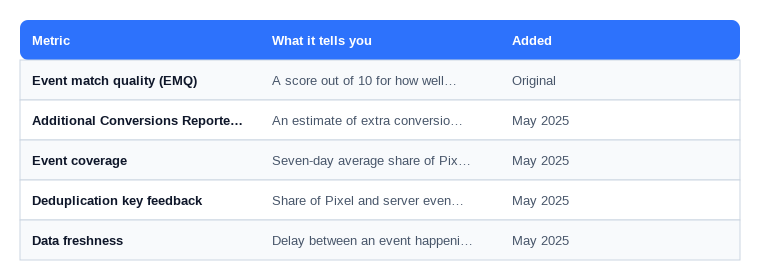
Which metrics does it report?
Each metric is returned per event name, for web events. Meta added them in stages, so an older tool may show only the first few.
| Metric | What it tells you | Added |
|---|---|---|
| Event match quality (EMQ) | A score out of 10 for how well the customer details you send can match events to a Meta account | Original |
| Additional Conversions Reported (ACR) | An estimate of extra conversions measured because of your Conversions API setup | May 2025 |
| Event coverage | Seven-day average share of Pixel events also covered by the Conversions API with shared deduplication keys | May 2025 |
| Deduplication key feedback | Share of Pixel and server events that arrived with each deduplication key | May 2025 |
| Data freshness | Delay between an event happening and Meta receiving it | May 2025 |
| Event spend and event ad sets | Ad spend tied to each event, and which ad sets use it | April 2026 |
| Value diagnostics and event delay | Missing or invalid value and currency, and upload latency | September 2026 |
How is event match quality scored?
Meta says EMQ is a score out of 10, calculated from which customer information parameters your server sends, the quality of that information, and the percentage of events that are matched to a Meta account. It is calculated in real time and is available only for web events. The API also lists each match key (such as email or IP address) with the percentage of events that carry it, so you can see which keys are missing. For ways to raise the score, read how to improve event match quality.
In September 2026 the diagnostics list gained six issue types: no client IP address, an IP that belongs to a privacy relay rather than the customer, IPv4 sent where IPv6 would match better, too small a share of events with the fbc click identifier, and a large share of events sharing one placeholder email or one placeholder phone number.
What do coverage, deduplication and freshness show?
Event coverage is the seven-day average percentage of Pixel events that the Conversions API also covers and that share deduplication keys. Meta’s own example: with ViewContent, AddToCart and Purchase on the Pixel but only Purchase sent from the server, coverage is 33%. It also notes that when coverage is below a 75% threshold, the extra conversions the Conversions API could add are worth monitoring.
Deduplication matters because, when both channels send the same event, Meta keeps one and discards the rest. Meta says to share deduplication keys for all your events, because the higher the percentage, the better. See how event deduplication goes wrong for the typical failure.
Data freshness measures the delay between the event and Meta receiving it. Meta says the Pixel defaults to real time and recommends sending server events in real time or as close to it as possible, because delayed events may affect how well ads reach the right audiences.
What do value diagnostics and event delay catch?
These two newer fields catch problems that leave your event counts looking healthy.
Value diagnostics report events whose value or currency is missing or invalid. Meta says those events still arrive but cannot be used for value optimization or ROAS-based bidding, so the loss is silent. Its example: a Purchase event with a 10% missing-value rate is losing a tenth of its optimization signal, and the cause is almost always one mis-mapped field. If the issue rate is absent, Meta says it means not computed, not zero.
Event delay reports the last seven days of upload latency: how many events arrived more than two hours late and more than 24 hours late. Meta says a high 24-hour share usually points to a nightly batch upload that should move closer to real time, while a high two-hour share with a low 24-hour share points to queueing.
Who can use the Dataset Quality API?
The call needs a dataset (pixel) ID and a valid access token. According to Meta, the person or system user making the call needs at least partial access with the “Use events dataset” permission. A system user in Meta Business Suite needs the Manage Pixel permission on each pixel. Apps need ads_read plus ads_management or business_management; managing many datasets or needing higher rate limits requires advanced access, which needs app review. The spend fields also need a token with ads_read or ads_management.
Advertisers can also generate a token in Events Manager. Hand these details to a developer, because they are setup work, not marketing work.
How should a marketing team use these numbers?
- Ask your developer or agency for a monthly extract per event, showing EMQ, coverage, deduplication, freshness, value and delay.
- Sort the events by spend, because Meta says event spend helps you prioritize: an event behind $50K of Sales campaigns is more urgent than one behind a $200 test.
- Fix value problems first on Purchase, since they affect ROAS-based bidding.
- Check coverage and deduplication together, because low coverage with missing keys is a setup gap.
- Move batch uploads closer to real time if delay is high.
- Re-pull the numbers after each fix and compare. Use Events Manager diagnostics for the single-pixel view.
Where does Bach.ai fit?
Bach.ai is our product. It audits Meta and Google Ads accounts and checks tracking and signal health, including pixel, Conversions API, event coverage and deduplication; it does not call the Dataset Quality API for you, and findings are estimates, not guarantees. On a paid plan a supported change is applied only after you approve it by default. For a wider review, use the Meta ads audit checklist and the Meta Pixel and Conversions API hub.
FAQ
Is the Dataset Quality API the same as Events Manager?
They show related information, but Events Manager works one pixel at a time. Meta says the API exists to consolidate the same kind of quality metrics programmatically at scale, which suits partners, agencies and advertisers with many datasets.
Do I need a developer to use it?
In practice, yes. The call needs a dataset ID, an access token and specific permissions on a system user or app. A marketer can ask for the extract and read the results without touching the setup.
Does it show metrics for app or offline events?
Meta says EMQ is currently available only for web events, and that other event types should be discussed with your Meta representative. Meta also lists an offline-events version in beta, so treat it as not generally available.
What does a low event coverage number mean?
It means few of your Pixel events are also arriving from your server with shared deduplication keys. Meta says that below a 75% threshold the extra conversions the Conversions API could add are worth tracking. Fix coverage and deduplication together.
Meta’s Conversions API best practices say that sending additional customer information parameters may help increase Event Match Quality, and that only matched events can be used for ads attribution and ad delivery optimization. Its verifying setup guide says events should be visible in Events Manager within 20 minutes of being sent.
Sources, read on 25 November 2026: Dataset Quality API; Best practices; Verifying setup.