What Parameters Does Every CAPI Event Need?
What parameters does every Conversions API event need?
Every event needs event_name, event_time in Unix seconds, action_source and user_data with at least one valid customer identifier. Website events also need event_source_url and client_user_agent. Purchase needs currency and value. Add event_id too, so Meta can deduplicate it against the browser pixel event.
A Conversions API request with a stale time stamp is not partly accepted: Meta returns an error for the entire request. This guide lists the fields every event needs, the extra ones for website events, the rule that catches late batches, and the deduplication fields that Meta calls optional but recommends on all events.
Which parameters are required on every event?
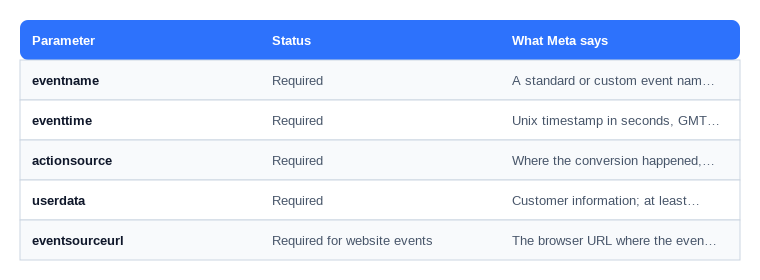
Meta’s server event parameters page marks four fields as required. Its best practices page repeats that action_source is required on all events and that event_source_url and client_user_agent are required on all website events.
| Parameter | Status | What Meta says |
|---|---|---|
| event_name | Required | A standard or custom event name; also used for deduplication |
| event_time | Required | Unix timestamp in seconds, GMT, up to 7 days before you send |
| action_source | Required | Where the conversion happened, for example website, app or physical_store |
| user_data | Required | Customer information; at least one correctly formatted parameter |
| event_source_url | Required for website events | The browser URL where the event happened; should match the verified domain |
| client_user_agent | Required for website events | The browser user agent; not hashed |
| event_id | Optional, recommended | Any unique string; used with event_name to deduplicate |
| custom_data | Optional | Business data such as currency and value |
What is the event_time rule?
event_time is a Unix timestamp in seconds, sent in the GMT time zone. It may be earlier than the moment you send the event, which allows batch processing. The limit is that it can be up to 7 days before you send it. Meta says that if any event_time in the request is more than 7 days in the past, it returns an error for the entire request and processes no events. For a batch, check the oldest event before you post, or one stale row blocks the rest.
Which action_source value do I use?
Meta lists nine values: email, website, app, phone_call, chat, physical_store, system_generated, business_messaging and other. By using the Conversions API you agree that the value is accurate to the best of your knowledge. For offline events the best-practices page says to choose the appropriate value, and that it should not be website. Choose the real channel, not the one that is easiest to code.
Which website events need extra fields?
Two parameters are required only for website events: event_source_url and client_user_agent. The URL should match your verified domain. The user agent is sent automatically by the browser pixel but must be configured manually for server events. Meta adds that sending both client_ip_address and client_user_agent on every event may help improve event matching. The IP address and user agent are never hashed, as covered in how to hash and format customer data.
What does a Purchase event need?
In custom_data, Meta’s custom data parameters page says currency is required for purchase events and must be a three-digit currency code, and value is required for purchase events or any event that uses value optimization. The value must represent a monetary amount. Send the order total in the currency of the sale and keep it consistent with the pixel. If amounts go missing on the browser side, read why Meta purchase events lose their value.
How do I set event_id for deduplication?
Meta says event_id is optional but recommended. For deduplication, the pixel’s eventID must match the server event_id, and the event names must match too. An order number or transaction ID works: if a customer makes orders 123 and 456, each Conversions API call carries its own order number and so does the matching pixel event, so Meta sees two purchases, not four. For events without an intrinsic ID, a random number works if browser and server send the same one.
Meta’s timing rule: if it finds a match between events sent within 48 hours of each other, it keeps only the first one, and if a server and a browser event arrive within 5 minutes, it favors the browser event. The best-practices page also allows a combination of external_id and fbp in place of event_id.
How do I assemble a valid event?
- Set
event_nameto the same standard name your pixel uses. - Set
event_timeto the Unix seconds when the action happened, in GMT. - Set
action_sourceto the real channel. - For website events, add
event_source_urlandclient_user_agent. - Add
user_datawith at least one hashed identifier, ideally email or phone. - For Purchase, add
currencyandvalueincustom_data. - Add
event_idequal to the pixeleventID, then test in Meta’s Test Events tool.
Where does Bach.ai fit?
Bach.ai is our product. It audits Meta and Google Ads accounts and checks tracking and signal health, including pixel and Conversions API event coverage and deduplication. It does not build or send your server events, and findings are estimates, not guarantees. On a paid plan a supported change is applied only after you approve it by default. For the full tracking review see the Meta pixel and Conversions API guide and the deduplication diagnostic.
FAQ
Is event_id required?
Meta marks it optional but recommends it for deduplication. If you send the same event from the pixel and the server, it also recommends identical event names and either an event_id or a combination of external_id and fbp.
Can I send events older than 7 days?
No. Meta says event_time can be up to 7 days before you send the event, and a request containing an older one fails entirely with no events processed. Send closer to real time, as Meta recommends.
Do offline sales use action_source website?
No. Meta’s best-practices page says offline events need the action_source parameter set to the appropriate value, and that it should not be website. Physical_store and phone_call are among the listed values.
What is the minimum user_data?
Meta says you must provide at least one user_data parameter with correct formatting. Meta also says an event with only certain thin combinations, such as gender plus location, is invalid. Add email or phone for matching strength.
Sources, read on 25 November 2026: Conversions API server event parameters; Conversions API best practices; Conversions API custom data parameters; Customer information parameters.