How to Split Budget Between Meta and Google Ads
How do I split my ad budget between Meta and Google Ads?
There is no universal split. Fund Google searches that already convert first, because that demand is finite, then give Meta the rest to create new demand. Move 10 to 20 percent of budget per step, wait one to two conversion cycles, and judge the result on total store revenue and margin, not on each platform's own ROAS.
Anyone who gives you a fixed 70/30 or 50/50 split between Meta and Google has not seen your account. The two platforms do different jobs. Google Search captures people who are already looking for what you sell, and that pool is limited by how many of them search. Meta creates demand among people who were not looking, and it can absorb more budget as long as creative and audiences hold up. A split is therefore a sequence of decisions, not a ratio.
For the earlier question of whether you need both, read whether an online store should use Facebook ads or Google ads.
What should you fund first?
Fund the demand that is finite and already proven. In practice that means brand searches and product searches on Google that have produced orders. Google’s own diagnostics warn what happens when you starve them: a campaign “Limited by budget” shows ads less often, and Google will not raise your budget for you (Fix “Limited by budget” status).
- In Google Ads, open Campaigns and filter Status by “Limited by budget”.
- Check which of those campaigns are profitable against your break-even ROAS.
- Raise those budgets first, by a modest step, until the status clears or returns flatten.
- Put the remaining budget into Meta prospecting, retargeting and creative testing.
What does a split look like in numbers?
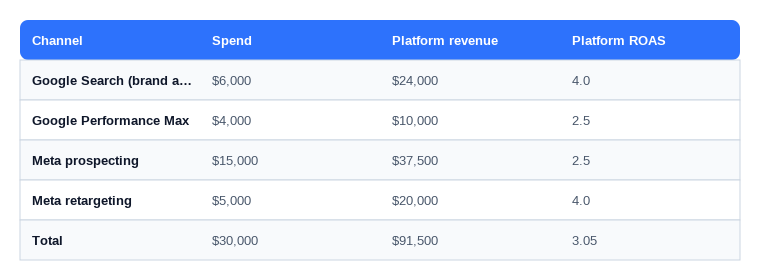
Illustrative only, with invented figures to show the method. A store has a 40% gross margin, so its break-even ROAS is 2.5.
| Channel | Spend | Platform revenue | Platform ROAS | Note |
|---|---|---|---|---|
| Google Search (brand and product) | $6,000 | $24,000 | 4.0 | Limited by budget |
| Google Performance Max | $4,000 | $10,000 | 2.5 | At break-even |
| Meta prospecting | $15,000 | $37,500 | 2.5 | At break-even |
| Meta retargeting | $5,000 | $20,000 | 4.0 | Small audience |
| Total | $30,000 | $91,500 | 3.05 | Platform view |
The platform view overstates reality, because each platform credits itself for the same buyers. The decision should use store revenue: if Shopify shows $70,000 for the month, blended MER is 70,000 ÷ 30,000 = 2.33, below the 2.5 break-even. Read why MER can tell a different story from platform ROAS. Here the extra dollar belongs in the Google Search campaign that is limited by budget, not in the channels already at break-even.
How do you move budget without breaking learning?
Move in steps and measure. Google advises avoiding frequent changes to bids, budgets and strategies, and waiting at least one to two conversion cycles before assessing performance (How to fix campaigns not running or low traffic). Apply the same discipline on Meta; see how to scale Meta budgets 20 percent without resetting learning.
- Pick one move per week: either raise a Google budget or shift Meta budget, not both.
- Change budget by 10 to 20 percent of that campaign’s spend.
- Record the date, the amount and the store revenue for the week before.
- Wait one to two conversion cycles, then compare total store revenue and contribution margin, not platform ROAS.
- Keep the change if blended return held; reverse it if it fell.
Google also states you may spend up to 2 times your average daily budget on a given day, while over a month you will not be charged more than your average daily budget allowed over 30.4 days (About Target ROAS bidding). Daily spend in your reports will therefore not match the budget exactly; judge pacing monthly.
Which numbers decide the split?
Use store-level numbers that neither platform controls:
- Blended ROAS or MER against your break-even, from store revenue.
- New customer revenue versus returning, because Google brand search often captures people Meta already introduced. See how to measure new vs returning customer revenue from ads.
- Contribution margin, after product cost, shipping, fees and returns.
The example above is not a benchmark. Per-platform ROAS targets differ by margin, average order value and repeat rate, and no published average replaces your own numbers.
Where does Bach.ai help?
Bach.ai reads Meta and Google Ads in one place and, with the read-only Shopify connection on Starter and Pro, compares the revenue each platform claims with real store orders, showing margin ROAS where product costs are available. On a paid plan it can apply an approved budget change on either platform; every change is logged and by default nothing is applied without your approval. It estimates recoverable spend and does not guarantee results.
What to do next
List every campaign, its spend and the revenue Shopify shows for the month, find the Google campaigns limited by budget that clear break-even, and fund those first. Use the ad spend calculator to size the total.
FAQ
Should I start on Google or Meta?
If people already search for your product, start with Google Search to capture existing demand. If few people search for it, start with Meta to create demand. Most stores add the second platform after the first is stable. Add the second channel only when the first one is predictable enough that you can tell what the new spend changed.
Is a 50/50 split a good default?
No. A fixed split ignores finite search demand, margins and creative capacity. Start with what has proven profitable and expand in steps. Move the split toward the platform that is proving profitable, one step at a time, and keep the rest steady while you watch the result.
How often should I change the split?
Weekly at most, one change at a time, with one to two conversion cycles between judgments, following Google’s guidance on avoiding frequent changes. Make one change, wait through the conversion cycles, then judge it, so you know what caused any movement in results.
Which ROAS do I trust?
Trust blended store numbers over either platform’s ROAS, because each credits itself. Platform ROAS is useful inside a platform to compare campaigns. When deciding how much each platform gets, compare the blended figure with each platform’s own number rather than choosing the more flattering one.
Sources
Checked 24 Nov 2026: Fix “Limited by budget” status; How to fix campaigns not running or low traffic; About Target ROAS bidding. The worked example uses invented figures.