Agency Checklist to Onboard a New Meta Ads Client
What should I audit when I onboard a new Meta ads client?
Audit six things before changing anything: who has access and whether two-factor authentication is on, whether the pixel and Conversions API record purchases, how the account is structured, which ad sets are learning limited, what creative and audiences are running, and a dated baseline report. Record each finding in writing.
A new client’s account tells you how it will go before you spend a dollar. The risk of skipping the audit is simple: whatever is broken becomes yours the moment you start editing. This checklist is the order we would work through in the first days, and each item says where to look.
What should I check first?
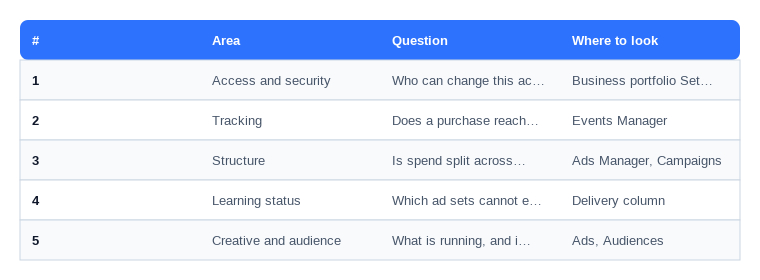
Check these six areas in this order, because each depends on the one before:
| # | Area | Question | Where to look |
|---|---|---|---|
| 1 | Access and security | Who can change this account? | Business portfolio Settings, Users |
| 2 | Tracking | Does a purchase reach Meta once? | Events Manager |
| 3 | Structure | Is spend split across too many ad sets? | Ads Manager, Campaigns |
| 4 | Learning status | Which ad sets cannot exit learning? | Delivery column |
| 5 | Creative and audience | What is running, and is it tired? | Ads, Audiences |
| 6 | Baseline | What do results look like before we start? | Ads Reporting |
For a longer version of the account checks, use the Meta ads audit checklist.
How do I audit access and security?
- Ask the client to share the ad account with your business portfolio as a partner, as set out in How do I manage many client ad accounts safely?
- In their portfolio Settings, list the people with full control. Meta recommends keeping that to ideally 10 or fewer, and two active people as a backup.
- Check that two-factor authentication is on; Meta says advertisers may be required to use it to publish ads.
- Remove people inactive for 90 days, per Meta’s security guidance.
- Open Activity history on a campaign and note who has been editing; Meta says anyone with the admin or advertiser role can change campaigns (activity history).
How do I audit tracking?
Open Events Manager, run Test events from the store and complete a test order. You want one Purchase event per order, with a value and currency, coming from both the pixel and the Conversions API without double counting. Meta explains how it deduplicates the two (about deduplication) and how event match quality is scored (about event match quality).
If a purchase is missing, fix tracking before anything else; optimisation has nothing to learn from. Our pixel and Conversions API guide covers the checks in detail. Then check the attribution setting on each ad set; Meta says results cannot be compared across ad sets with different attribution models (attribution settings).
How do I audit structure and learning status?
- In Ads Manager, list campaigns and ad sets with their daily budgets.
- Add the Optimization events column: open Columns, click Customize columns and tick Optimization events.
- Read the Delivery column. Meta says Learning limited means the ad set is unlikely to receive about 50 optimization events in the week after its last significant edit (about learning limited).
- Note the cause Meta lists: small audience, low budget, low bid or cost control, high auction overlap, an infrequent optimization event, or too many ads at once.
- Sketch the fix, but do not apply it yet: combining ad sets, expanding the audience, raising budget or choosing a more frequent event.
Audience overlap is a common finding in inherited accounts; How do I check and fix audience overlap on Facebook? shows the checks.
How do I audit creative and audiences?
Sort ads by spend and read each top ad’s creative, text and landing page together. Record how many distinct concepts run, how old they are, and whether frequency is climbing. In Audiences, record which custom audiences exist, their status and whether customers are excluded from prospecting, using How do I exclude existing customers from Meta ads?.
Meta’s opportunity score (0 to 100) and its recommendations are a useful cross-check, but Meta says the score does not reflect actual or future performance (about opportunity score). Treat it as a to-do list, not a grade.
What baseline should I write down?
Before any edit, build a dated report: last 30 and 90 days, spend, purchases, cost per purchase and ROAS by campaign, plus the client’s own store revenue for the same dates. Keep the attribution setting and currency on the page. How do I report Meta ads results to clients? shows how to build and schedule it. This baseline is what you compare against in month two, and what protects both sides when results are discussed.
What should I do with the findings?
Sort them into three buckets and show the client:
- Fix now: broken tracking, security gaps, an unsafe level of access.
- Fix in the first month: structure, learning limited ad sets, missing exclusions.
- Test: creative and audience hypotheses, one change at a time.
Agree the first two weeks’ changes in writing, and make one change per ad set at a time so the cause of any movement is clear. Meta assesses learning limited from your last significant edit, so each big change starts a new clock, which is why the order matters.
Can software help?
Bach.ai runs an audit on a connected Meta or Google Ads account and ranks each finding by estimated recoverable spend in the client’s currency, covering creative fatigue, budget and bidding, audience saturation and learning health, and tracking and signal health. The Agency plan covers up to 20 brands. By default, it applies a supported change only after you approve it, and the figures are estimates, not promised savings.
FAQ
How long does an onboarding audit take?
A few hours for a small account if tracking is healthy, and longer when tracking, structure and access all need fixes. Do not let it stretch: the point is a written baseline and a short list of fixes, not a perfect account.
Should I change anything before the audit is done?
No, apart from a security gap or a live tracking failure. Edits made before you record the baseline blur cause and effect, and Meta assesses learning limited from the last significant edit, so each big change starts a new clock.
What if the client has no access records?
Use Activity history to reconstruct changes and ask who the current full-control people are. If nobody has full control, Meta offers a request process for the portfolio, which the client has to start.
Do I need the client’s store data?
Yes. A Meta-only audit cannot tell you whether the revenue Meta reports is real. Ask for read access to orders or a weekly export, and compare it with the platform figures.
Sources: Meta Business Help Center, Best practices for making a business portfolio more secure, View activity history, About deduplication for Meta Pixel and Conversions API events, About event match quality, About attribution models and attribution settings, About learning limited, About opportunity score (all checked 24 Nov 2026); Bach.ai capabilities from our features page.