Should the Agency or the Client Pay for Meta Ads?
Should the agency or the client pay for Meta ads?
Default to the client's own payment method on the client's ad account, so the agency carries no spend risk and the client keeps the billing history. If the agency fronts the spend, agree the cap, billing cycle and any markup in writing, because Meta charges when payment thresholds are reached, not on invoice dates.
Who pays Meta decides who carries the risk when a client pays late, a card fails or a campaign overspends. This guide sets out how Meta’s billing works, so the choice is made on facts, then a default with exceptions.
How does Meta bill for ads?
Meta says the payment method you add when you create your first ad determines your payment settings. There are two main modes: automatic billing, where you are charged when you reach a payment threshold and again on your monthly bill date for what remains, used with PayPal and most credit and debit cards; and available funds, where you add money in advance and Meta deducts from the balance up to once a day (How Meta charges for ads).
A payment threshold is an amount you can spend before you are charged. Meta sets it automatically to a small amount at first, and may raise it as you make successful payments (About payment thresholds). Because you can reach a threshold more than once a month, Meta says you may be charged several times in a month, even with one ad, and charged after you stop running ads.
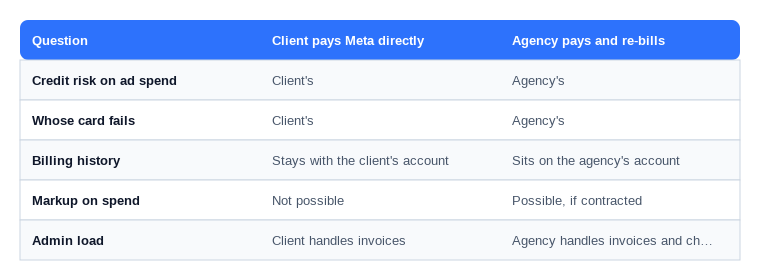
Who should hold the payment method?
| Question | Client pays Meta directly | Agency pays and re-bills |
|---|---|---|
| Credit risk on ad spend | Client’s | Agency’s |
| Whose card fails | Client’s | Agency’s |
| Billing history | Stays with the client’s account | Sits on the agency’s account |
| Markup on spend | Not possible | Possible, if contracted |
| Admin load | Client handles invoices | Agency handles invoices and chasing |
| Cash flow | No float needed | Agency fronts spend until paid |
For most agencies the client-pays route is the safer default. Fronting spend can make sense for small clients who cannot manage billing, or when you buy at scale, but then you take the risk.
What should the contract say if the agency pays?
- The monthly media budget and how it can change.
- A hard cap, set as an ad account spending limit; see How do I set a spending cap on a client’s Meta ad account?.
- The invoice date and payment terms, and what happens to ads if the client pays late.
- Whether the fee is calculated on Meta’s amount spent or on what Meta invoices. Meta notes budget may differ from the actual amount spent, and that location fees may appear on invoices for ads delivered in specific jurisdictions.
- Who pays tax and location fees.
- What happens to the ad account and its payment method if the contract ends.
What happens if a payment fails?
Ads can stop. Meta explains the failed-payment flow in its help pages; Why did my Meta ads payment fail? and How does the Facebook ads billing threshold work? cover the symptoms. Whoever’s payment method is on file has to fix it, so decide in advance who that is. If the agency’s card is on a client account, the agency carries the fix and the delay. If the client’s card is on it, the client does. Put that in writing.
What does fronting spend cost the agency?
Illustrative arithmetic, not a benchmark. Suppose an agency fronts $20,000 a month of media for four clients and clients pay 30 days after invoice. The agency carries $20,000 of float at all times, and one client that pays 30 days late adds up to $5,000 of extra exposure for a month. If the agency adds a 5% handling fee to cover that, it earns $1,000 a month, which is thin against a single default. The point is not the numbers, it is that the float is a real balance-sheet commitment that your management fee does not price in. Before you front spend, calculate your own worst-case exposure and confirm the markup, if any, covers it.
Clients who prefer the agency to pay are often small brands with no finance function. For them, offer a prepay model: the client pays you into a held balance before spend, and you pay Meta as the account bills. That keeps float near zero.
How do I avoid billing surprises?
Use a spending limit as a backstop, check the account’s payment settings weekly, and calendar the monthly bill date. Reconcile Meta’s charges to your own report each month; if they differ, the usual reasons are timing (threshold charges), budget versus actual spend, and location fees. For a baseline of the account’s billing and access on day one, use the Meta ads audit checklist, and for who owns the account see Who should own a client’s Meta ad account?.
Can software help?
Bach.ai can flag pacing and spend patterns across connected accounts, and the Agency plan covers up to 20 brands, priced custom through the pricing page. It does not move money or hold a payment method for Meta; billing stays inside Meta’s settings.
FAQ
Can I charge a markup on ad spend?
Only if the agency pays Meta and re-bills, and only if the contract says so. Be transparent about it, because clients can see Meta’s charges in their own account when they pay directly.
Why was my client charged twice in a month?
Meta says you may be charged each time you reach your payment threshold, plus on your monthly bill date for remaining costs.
What is available funds?
A prepaid balance you add to the ad account, from which Meta deducts as ads run. Spending limits cannot be set on accounts that use it.
Does the budget equal the bill?
Not exactly. Meta says the actual amount spent can differ from the budget and that typically you will not be charged beyond your set budget.
Sources: Meta Business Help Center, How Meta charges for ads, About payment thresholds for Meta ads, About ad account spending limits (checked 25 Nov 2026); Bach.ai capabilities from our features page and pricing.