How Should an Agency Price Meta Ads Management?
How should an agency price Meta ads management?
Choose a model you can defend: a flat retainer scaled to account complexity, a percentage of ad spend with a minimum, or a hybrid. Define the fee base in writing, because Meta's budget, amount spent and invoiced charges differ, and price creative production separately from media management.
Pricing is where agencies lose margin quietly. A percentage of spend rewards you for growing the budget even when results are flat; a flat fee can drift away from the effort the account demands. This post lays out the three models with arithmetic you can adapt. The figures are illustrative, not market averages, because published price ranges are mostly vendor opinion and we found no audited source.
What are the common pricing models?
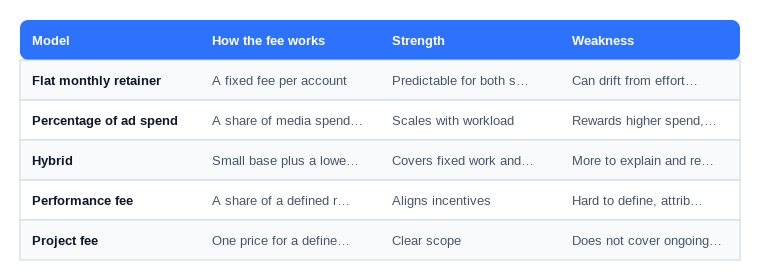
| Model | How the fee works | Strength | Weakness |
|---|---|---|---|
| Flat monthly retainer | A fixed fee per account | Predictable for both sides | Can drift from effort as spend grows |
| Percentage of ad spend | A share of media spend, often with a minimum | Scales with workload | Rewards higher spend, not better results |
| Hybrid | Small base plus a lower percentage | Covers fixed work and growth | More to explain and reconcile |
| Performance fee | A share of a defined result | Aligns incentives | Hard to define, attribution disputes |
| Project fee | One price for a defined deliverable | Clear scope | Does not cover ongoing optimisation |
Search results for this question show ranges for retainers and percentages, but those come from agency and vendor blogs selling services, so treat them as positioning. Price from your own cost per hour and your capacity.
How do I work out my price from cost?
Use a floor-up method:
- Estimate hours per month for the account: setup, weekly optimisation, reporting, meetings and creative briefing.
- Multiply by your fully loaded cost per hour, including tools and management time.
- Add the margin you need.
- Compare the result with a percentage of the client’s spend. If the percentage is far lower than your cost-based price, the client’s spend is too small for a percentage model; use a retainer or a minimum.
- Round to a clean number and write it down.
Illustrative example: 10 hours a month at a $60 loaded cost is $600; at a 40% margin target the price is $1,000. If the client spends $5,000 a month, that is 20% of spend, so a flat fee suits better than a percentage. If the client spends $50,000, $1,000 is 2% of spend, and the agency is underpriced unless the workload is really that light.
How do I define the fee base?
If you charge a percentage, say which number it applies to. Meta distinguishes budget, the amount you allocate, from amount spent, the approximate total spent, and notes the actual spend may differ from budget (How Meta charges for ads). It also says location fees may appear on invoices for ads delivered in specific jurisdictions. Decide whether your base is amount spent in Ads Manager, the amount Meta invoices, or the agreed budget, and whether taxes and fees count.
Meta’s billing also runs on payment thresholds, and Meta says you can be charged after you stop running ads (About payment thresholds). If you bill on invoices, align to a calendar month of Ads Manager spend and say so.
What should creative cost?
Price creative separately from media management. Producing ads, editing video and running tests take different hours from account optimisation, and bundling them hides the real driver of cost. A clear menu works: media management retainer, plus a monthly creative package with a defined number of concepts, plus optional extra tests. What parts of an agency retainer can software replace? shows which tasks are still human work.
What should the scope say?
- Channels: Meta only, or Meta and Google.
- Number of ad accounts and brands.
- Reporting cadence and format.
- Creative deliverables and revision limits.
- Meetings per month.
- Tracking and landing page work: included or extra.
- What counts as out of scope, and the hourly rate for it.
- Notice period and how access is handed back; see How do I offboard a client from Meta ads?.
How do I handle a client who wants performance-only pricing?
Be cautious. A share of results needs an agreed definition of the result, a source of truth and an attribution rule. Meta says results cannot be compared in the Campaign Overview table across ad sets with different attribution models, so a performance fee based on platform numbers invites disputes. If you agree to one, base it on the client’s own order data, agree the attribution window in advance and add a minimum fee. Why does Meta show more purchases than Shopify? shows why the two numbers differ.
Can software change my pricing?
It can change your hours. If audits, reporting and routine checks take less time, your cost to serve falls, and you can either lift margin or take on more clients; How can an agency take on more clients without hiring? works through that. Bach.ai lists the Agency plan as custom-priced for up to 20 brands (pricing); it applies changes only after your approval by default on a paid plan. Software does not set your fee. It lowers the cost under it. To see what a client’s spend does to your own tooling costs, the ad spend calculator shows the monthly arithmetic.
FAQ
Is percentage of spend a bad model?
Not inherently. It scales with workload, but it rewards spend, not results. Add a minimum fee and a quarterly review of workload against fee.
How much should I charge for creative?
Price it from hours per concept, plus tools and revisions. Do not copy a market range; no audited source exists.
Should I include ad spend in my invoice?
Only if you pay Meta. If the client pays Meta directly, invoice your fee alone; see Should the agency or the client pay for Meta ads?.
When should I raise a client’s fee?
When workload rises, spend crosses a threshold you wrote in the contract, or scope expands. Put the trigger in writing at the start.
Sources: Meta Business Help Center, How Meta charges for ads, About payment thresholds for Meta ads, About attribution models and attribution settings (checked 25 Nov 2026); WebSearch on agency pricing 25 Nov 2026 (vendor and agency blogs, used only to confirm the question exists; no figures taken); Bach.ai capabilities from our features page.