How to Write Responsive Search Ads for a Store
How do I write responsive search ads for an online store?
Enter at least 3 headlines (up to 15, 30 characters each) and 2 descriptions (up to 4, 90 characters each) that each make sense alone, because Google mixes them in any order. Cover product, benefit, shipping and returns, pin only what must appear, and run at least 2 responsive search ads per ad group.
A responsive search ad is not one ad; it is a pool of headlines and descriptions that Google Ads assembles for each search. For a store, that means you write the pool once and the system tests combinations against real queries. Your job is to give it varied, honest raw material: what you sell, why it is worth buying, and what shipping and returns look like. Everything below comes from Google’s own help pages, read on 25 November 2026.
How many headlines and descriptions can a responsive search ad hold?
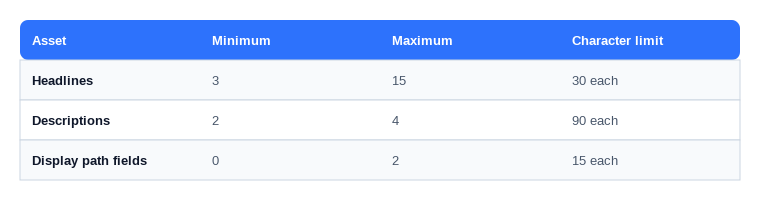
Google says you can provide up to 15 headlines and 4 descriptions for a single responsive search ad. You must enter a minimum of 3 headlines and 2 descriptions. Headline fields support up to 30 characters, description fields up to 90 characters each, and the two path fields up to 15 each. In a double-width language such as Japanese, every character counts as 2.
Google also says a minimum of one headline and one description is selected to show in different combinations and orders, and that ads can show up to 3 headlines in the traditional headline position. Because order is not guaranteed, every line must read sensibly next to any other line.
| Asset | Minimum | Maximum | Character limit |
|---|---|---|---|
| Headlines | 3 | 15 | 30 each |
| Descriptions | 2 | 4 | 90 each |
| Display path fields | 0 | 2 | 15 each |
What should a store put in its headlines?
Google’s tips say to include at least one of your keywords in your headlines, to highlight product or service benefits or a problem you are solving, and to mention shipping and returns information. Treat the 15 slots as five groups of three:
- Name the product or category the way shoppers search for it, using your keyword.
- State one concrete benefit, such as a material, a fit or a use case.
- Remove a purchase worry: delivery window, free returns or a guarantee you really offer.
- Add a call to action: shop, compare, see sizes.
- Differentiate with a fact only you can claim, such as a range, a maker or a size run.
Keep each line self-contained. Google tells you to write the first 3 headlines as if they appear together, and warns that headlines and descriptions may show in any order.
When should I pin a headline?
By default every headline and description can appear in any position. Google lets you pin text to a position, and gives the example of a disclaimer that must show in every ad. It also states that if you have text that should appear in every ad, you must pin it to Headline position 1, Headline position 2 or Description position 1.
Pinning trades flexibility for control, so pin only what policy or the law requires, such as a legal line or a trademark. Everything else is better left free, because the more headlines and descriptions you enter, the more opportunities Google Ads has to serve an ad that matches the query.
How do I know if my ad is good enough?
Ad Strength is Google’s feedback tool. It measures the relevance, quality and diversity of your ad assets and rates them Poor, Average, Good or Excellent. Google recommends at least 2 responsive search ads with a Good or Excellent rating per ad group, each with a unique final URL. Google reports that advertisers who move Ad Strength from Poor to Excellent see 15% more clicks and conversions on average, and that going from one to two ads in a group lifted conversions 6.6% at a similar cost per conversion. These are Google’s own averages, not a promise for your account.
Ad Strength measures variety, not profit. A store should still check the ad against its own margin and its landing page.
How do I read the combinations report?
Open Campaigns, then Ads, find the ad, click View assets details and open the Combinations tab. The report shows impressions for the combinations that served and the most common asset combinations. Google warns that it shouldn’t be used to create static versions of responsive search ads, because those are not guaranteed to perform the same: responsive search ads use real-time signals. Use it to spot headlines that never appear or to prune a weak line, not to freeze a winning ad.
What mistakes cost stores the most?
- Writing 15 headlines that say the same thing. Variety is part of the Ad Strength score.
- Editing live ads often. Google notes that removing or editing headlines or descriptions can change the ads that are serving and may affect performance.
- Pinning everything. That turns a responsive ad back into a fixed one.
- Sending every ad to one generic page. Match the final URL to the product or category in the ad group.
Related reading: how to read search terms and add negatives, what Google Ads Quality Score tells you and the responsive search ads glossary entry.
Where does Bach.ai fit?
Bach.ai is our product. It audits a connected Google Ads account and flags where spend goes to weak ads, and on an active paid plan it can apply a supported change after you approve it, by default. It does not write your brand voice, so the ad text above stays your job.
FAQ
How many responsive search ads should one ad group have?
Google recommends at least 2 with Good or Excellent Ad Strength, each with its own final URL. Its own averages show conversion gains when an ad group goes from one to two or three ads, though your results will differ.
Can I put a price in a headline?
Yes, if it is accurate and matches the landing page. Prices change, and a stale price in an ad risks a policy problem. A price asset or a sale line you update often is safer than a hard-coded number.
Do I need to include keywords in headlines?
Google’s tip is to include at least one of your keywords in your headlines and to make headlines relevant to the keywords you target. Relevance helps both Ad Strength and the shopper.
Is a higher Ad Strength always better?
No. Ad Strength rates relevance, quality and diversity of assets. It cannot see your margin, stock or landing page, so an Excellent ad can still lose money.
Sources
Sources, each opened and read on 25 Nov 2026: Google Help pages, About responsive search ads; About Ad Strength; About the combinations report for responsive search ads. Menu names and limits change, so check the page before you act.