Should You Send fbp, fbc and fbclid to Meta?
What are fbp, fbc and fbclid, and should I send them?
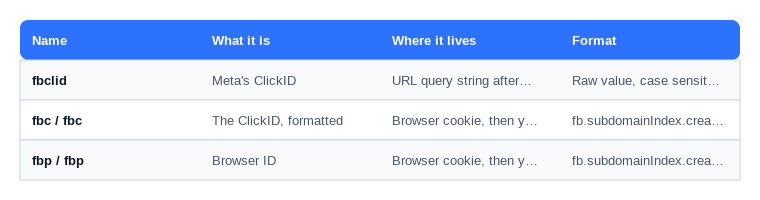
fbclid is the click ID Meta adds to your landing-page URL after an ad click. fbc is that ID saved in a cookie in a fixed format, and fbp is a browser ID cookie set by the pixel. Meta recommends sending fbc and fbp with your server events whenever available, unhashed.
Three short strings decide whether Meta can tie a server-side purchase back to the ad click and browser that produced it: fbclid, fbc and fbp. They look similar and are easy to mix up. This guide separates them, shows the exact format Meta expects, and covers the storage rule that keeps the value from being lost between the ad click and the order.
What are fbclid, fbc and fbp?
Meta’s guide to fbp and fbc explains that ClickID is a Meta-generated parameter passed in the URL of your website when someone clicks an ad on Facebook or Instagram. The URL parameter is called fbclid. Meta says sharing it can help you attribute more conversions and reach more people.
| Name | What it is | Where it lives | Format | Hashed? |
|---|---|---|---|---|
| fbclid | Meta’s ClickID | URL query string after an ad click | Raw value, case sensitive | Not sent on its own |
| _fbc / fbc | The ClickID, formatted | Browser cookie, then your server event | fb.subdomainIndex.creationTime.fbclid | No |
| _fbp / fbp | Browser ID | Browser cookie, then your server event | fb.subdomainIndex.creationTime.randomnumber | No |
Meta’s customer-information page marks both fbc and fbp as “Do not hash”.
Should I send fbp and fbc?
Yes, when you have them. Meta says it recommends that you always send the _fbc and _fbp browser cookie values in the fbc and fbp event parameters when available, and that you send fbc with every event you send to the Conversions API. Its best practices add that these values are subject to change, so you should refresh them regularly, using the latest value for each user.
How do I read the fbclid and the cookies?
Meta gives two places to look:
- The URL. When fbclid is present in the query string, try to read it server-side from the HTTP request URL. Meta warns the value is case sensitive: do not lowercase or uppercase it or otherwise modify it before use.
- The cookies. If the Meta pixel is installed, the pixel stores the ClickID in the
_fbccookie once available. The cookie also exists if you already store the ClickID in it from your server. The pixel saves a unique identifier to_fbpwhen it uses first-party cookies and no_fbpexists yet.
If no pixel runs on the site, you can still build fbc from an fbclid in the page URL.
How do I format fbc and fbp?
Both follow the pattern version.subdomainIndex.creationTime.value:
- version is always the prefix
fb. - subdomainIndex says which domain the cookie is defined on:
comis 0,example.comis 1,www.example.comis 2. If you generate the value on a server and are not saving a cookie, use 1. - creationTime is the Unix time in milliseconds when the cookie was saved. If you did not save it, use the time you first observed the value.
- value is the fbclid for
fbc, or a random number generated by the pixel forfbp.
Meta’s example fbc is fb.1.1554763741205.AbCdEfGhIjKlMnOpQrStUvWxYz1234567890, and its example fbp is fb.1.1596403881668.1116446470. If you use Meta’s parameter builder library, the format carries an extra appendix at the end of each value, so follow that library’s page instead.
How do I store the ClickID so it survives to purchase?
- Read the fbclid from the landing-page URL on the first request.
- Format it as
fb.subdomainIndex.creationTime.fbclidwith the current time in milliseconds. - Set it in an
_fbccookie in the HTTP response header with a 90-day expiry, as Meta highly recommends. - Set the cookie only if
_fbcdoes not already exist, or if the fbclid in the URL differs from the one stored in the cookie (the part after the last dot). - As an alternative, keep the formatted value in your own backend storage, and always store the most recent value from the URL.
- Send
fbcandfbpinuser_dataof each Conversions API event, unhashed.
What changes if the pixel is not on the page?
Without the pixel there is no _fbc cookie to read, so steps 1 to 3 are your job. The fbclid arrives on the landing page, so if your checkout sits on another domain, store the value before the shopper leaves that page. The deduplication side of the same setup is covered in the Meta pixel and CAPI deduplication diagnostic, and how to improve event match quality shows what else to send.
Where does Bach.ai fit?
Bach.ai is our product. It audits Meta and Google Ads accounts and checks tracking and signal health, including pixel and Conversions API event coverage and deduplication. It does not set cookies on your site or send server events, and findings are estimates, not guarantees. On a paid plan a supported change is applied only after you approve it by default. See the Meta pixel and Conversions API guide and the pixel and CAPI signal-health audit.
FAQ
Is fbclid the same as fbc?
No. The fbclid is the raw value Meta appends to the URL. The fbc is that value wrapped in the required format, fb.subdomainIndex.creationTime.fbclid, and stored in the _fbc cookie or sent as the fbc event parameter.
Do I hash fbp or fbc?
No. Meta marks both as parameters you must not hash. Hash email, phone and name fields instead, and send the IP address and user agent unhashed as well, exactly as they were collected.
What should I check if my fbc looks wrong?
Check that the fbclid was not changed, because Meta says it is case sensitive. Then check the prefix, the subdomain index, and that the creation time is in milliseconds rather than seconds.
Will the fbclid replace my other tracking parameters?
No. Meta says ClickID auto-attachment does not impact other custom tracking parameters you may have enabled. They sit side by side, so keep your existing parameters and also read the fbclid.
Sources, read on 25 November 2026: Managing fbc and fbp parameters; Customer information parameters; Conversions API best practices.