What to Delegate to an AI Media Buyer vs a Human
Which media buying tasks should I delegate to AI?
Delegate monitoring and drafting: account audits, budget pacing, creative-fatigue and tracking checks, reporting and proposed changes. Keep strategy, offer, margin targets, creative direction and any change that spends money behind a human approval. Trial it for four weeks on read access first.
The useful question is not whether an AI media buyer can replace a person, but which of the buyer’s jobs are checking and which are choosing. Checking is repetitive, rule-shaped and benefits from never getting tired. Choosing depends on what the business wants, which is not in the ad account. This post splits the job along that line, and says how to test the split before you trust it.
Which media buying tasks suit AI?
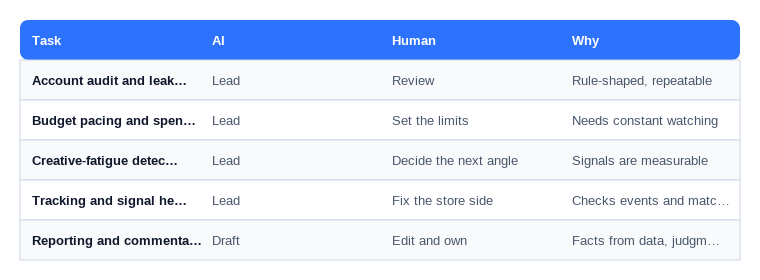
| Task | AI | Human | Why |
|---|---|---|---|
| Account audit and leak finding | Lead | Review | Rule-shaped, repeatable |
| Budget pacing and spend alerts | Lead | Set the limits | Needs constant watching |
| Creative-fatigue detection | Lead | Decide the next angle | Signals are measurable |
| Tracking and signal health | Lead | Fix the store side | Checks events and matching |
| Reporting and commentary draft | Draft | Edit and own | Facts from data, judgment from you |
| Proposing bid, budget or audience changes | Draft | Approve | Changes spend |
| Applying approved changes | Execute with logs | Approve first | Accountability |
| Offer, pricing and positioning | Input only | Lead | Not in the account |
| Margin target and break-even | Calculate | Decide | Depends on business |
| Creative strategy and brand voice | Assist | Lead | Judgment and taste |
| Client or stakeholder conversations | None | Lead | Trust |
“Lead” means the AI does the first pass; it does not mean it acts unchecked. The split is our view, based on how Meta’s tools are built, not a benchmark.
What does Meta’s own tooling show about this split?
Meta’s ads MCP server groups what an agent can do into reporting, ad creation and management, catalogs, signals, help, A/B tests and activity logs, and says write tools create entities paused, with the client asking for confirmation before activation (overview, tools). So the reading side is routine, and the spending side has a stop built in. That is the shape of a safe delegation: let the agent look everywhere, and make it ask before it spends.
How do I trial delegation in four weeks?
- Week 1, read only. Give the agent read access and ask it to audit the account. Compare its findings with your own list. Use the Meta ads audit checklist as the answer key.
- Week 2, watch and propose. Ask for the changes it would make, with the evidence for each. Approve none; note which you would have made.
- Week 3, approve one class. Pick one low-risk change type, such as pausing an ad that has spent past a threshold without a purchase, and approve its proposals one by one.
- Week 4, review the log. In Ads Manager, open Activity history and filter Changed by to the agent’s identity; Meta says the history shows who changed what and when (activity history).
Only widen the scope if the proposals matched your judgment and the log matches the proposals. What permissions to grant at each step is covered in What permissions should an AI agent have on my ad account?
What should stay with a human, always?
- The margin line. Whether a 2.1 ROAS is good depends on your costs; use How do I calculate my break-even ROAS?.
- The offer and the product page. An agent cannot fix a weak offer by editing a budget.
- Creative direction. An agent can see a creative is fatigued; choosing the next idea needs taste and customer knowledge.
- Anything that reaches customers or moves large budgets. Keep approval on, whatever the tool offers, and treat any automatic mode as something to switch on for one narrow action type after the trial.
- Accountability. If a change is wrong, a named person owns it.
Is an AI media buyer a replacement for hiring?
Rarely a full one. The honest framing is capacity: an AI buyer can watch every account all day and draft changes, so a person manages more accounts or spends more time on strategy. Is an autonomous media buyer a real product category? examines that claim, and What should my first media buyer own? covers what a first hire should keep. For a small brand, the split above may mean you run the account yourself with software doing the watching.
What does it look like in numbers?
Illustrative, not a result. Suppose a person spends 6 hours a week on account checks and reports across a brand’s ad accounts. If software takes the first pass at the checks and the report draft, and the person spends 2 of those hours reviewing, the freed 4 hours go to creative briefs and tests. Whether that happens depends on how well the tool’s findings hold up in your account, which is what the four-week trial measures. Do not plan a headcount on a vendor’s time-saving claim.
Can software help?
Bach.ai is built around this split: it audits Meta and Google Ads accounts, ranks findings by estimated recoverable spend in your currency, drafts the next creative angle for a fatigued ad, and applies a supported change on Meta or Google, by default, only after you approve it (Auto-Pilot is opt-in) on an active paid plan, with every change logged. The figures are estimates, not guaranteed savings. For the market overview, see the best Meta ads tools.
FAQ
Can an AI media buyer run my ads unattended?
Technically some can, but it is the riskiest setting. Delegate checking and drafting first, keep approval on anything that spends money, and widen the scope only after the log matches the proposals. A written daily spend cap in the ad account is a useful backstop.
What should I never automate?
Offer, pricing, positioning and the margin target, since the agent cannot see them. Also customer-list uploads and large budget moves, which should always pass a person. Keep the agent on checking and drafting for these decisions, and let a human approve anything that changes what you offer or spend.
How do I know the AI’s findings are right?
Check a sample against your own reading and the platform’s figures. For tracking claims, compare with Events Manager; for spend claims, with Ads Manager. A finding with no evidence you can open is a guess. Ask for the report or setting behind each finding, and reject any claim you cannot trace back to a screen you can open yourself.
Will a human buyer still be needed?
For strategy, creative direction and accountability, yes. An AI buyer changes how much a person can watch and how fast checks happen; it does not take over the decisions that depend on the business.
Sources: Meta for Developers, Ads MCP server overview and Ad creation and management tools; Meta Business Help Center, View activity history (checked 24 Nov 2026); Bach.ai capabilities from our features page and product facts.