What AI Marketing Operations Platforms Automate
What do AI marketing operations platforms actually automate?
They automate repeatable execution: generating creative variants, launching ads in bulk, running rules on a schedule and assembling reports. A person still sets strategy, approves claims and brand fit, checks compliance and judges whether a result was caused by the ad. Judge a platform by which of those tasks it does and who approves.
“AI marketing operations platform” is a label vendors apply to very different products: a bulk ad launcher, a rules engine, a creative generator, or an agent that reads your account. What they share is that they take over execution tasks. This post separates what the vendors’ own pages say they automate from what still needs a person, then gives a way to evaluate one. Every vendor line was read on 24 November 2026; none is a ranking.
What do these platforms actually automate?
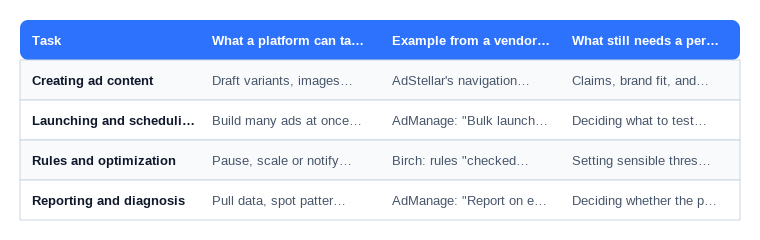
Four kinds of work show up across vendor pages. The examples are quoted from each vendor’s own site.
| Task | What a platform can take over | Example from a vendor page | What still needs a person |
|---|---|---|---|
| Creating ad content | Draft variants, images, video, copy | AdStellar’s navigation lists AI image ads, AI video ads and an ad clone tool | Claims, brand fit, and an AI label where required |
| Launching and scheduling | Build many ads at once, schedule tests | AdManage: “Bulk launch ads to Meta, TikTok, Google and 12 more channels”; Birch: put weekly tests on auto-launch | Deciding what to test and why |
| Rules and optimization | Pause, scale or notify on a condition | Birch: rules “checked every 15 minutes”; Meta’s own automated rules | Setting sensible thresholds; watching overall results |
| Reporting and diagnosis | Pull data, spot patterns, answer questions | AdManage: “Report on every ad in one place”; Motion: AI tagging and a leaderboard | Deciding whether the pattern caused the result |
Which creative and scheduling tasks can be automated today?
Creation is the most automated and the most risky. AdStellar’s pricing page, for example, shows one plan at $100 a month with $2 per 1,000 AI credits and 50,000 credits a month, and its menu lists image, video, avatar and UGC-style ad generators. Madgicx’s page describes an “Automated Ad Launch Tool”. Bach.ai drafts a next angle to test and, on Pro, includes 50 creative generations a month.
Scheduling is more mature and less risky. Meta’s own automated rules help manage ads, and Meta’s help page gives examples such as turning off a specific campaign every Friday or increasing budget based on return on ad spend. Birch’s page says weekly creative tests can run on auto-launch with one-click approval. These tasks are deterministic: the rule says what happens, and you can read it.
What still needs a human?
Four things, and a platform that claims otherwise should be questioned:
- Strategy. What to sell, to whom, at what margin.
- Claims and brand fit. Google notes that AI regulations in several regions require ads with certain AI-generated or edited assets to carry disclosures, and that its AI label setting does not guarantee compliance with specific regulations. Meta says ads with certain generative edits may show an AI info label. Someone must own that.
- Approval of changes. Meta says any action an agent takes on your behalf requires your authorization through the agent. Ask any platform the same question.
- Causation. A platform can report that results moved after it changed something. Whether the change caused it needs a test; see How do I structure a clean creative test on Meta?.
Meta itself tells advertisers to keep watching: its automated rules page says that while rules may cut down the time needed to manage your ads, you should still monitor overall performance.
How do I evaluate an AI marketing operations platform?
Run this list before a trial and write down the answers:
- List the three tasks you do most often by hand, and score each platform only on those.
- Ask which actions it takes without you and which wait for approval; get it in writing.
- Find the change log and check that it matches Meta’s Activity history or Google’s Change History.
- Price it at your real spend and volume. Models differ: per-credit, per-ad-account and ad-spend brackets all appear on the pages above.
- Check which platforms it reads and writes: Meta only, or Google, TikTok and others too.
- Test on one ad account with real tasks for the length of its trial, then compare time saved with time spent checking.
- Confirm how you leave: export of your data and how fast you can switch it off.
For approval and audit specifics, see How do I evaluate an AI ads tool before buying? and How do I design a safe ad automation workflow?. For a tool list by job, see the best Meta ads tools.
Where does Bach.ai fit, and where does it not?
Bach.ai is our product. It sits in the reporting and diagnosis row: it audits Meta and Google Ads, sizes each leak in money, drafts the next creative angle to test, and on an active paid plan applies a supported change, by default, only after you approve it (Auto-Pilot is opt-in). It is the wrong choice if you want bulk launching across many channels, a scheduler for social posts, or an autonomous media buyer with no approval step. Starter is $99/mo and Pro is $149/mo, each including $10k/mo of ad spend, then 1% or 1.5% of spend above it (pricing).
FAQ
Do AI marketing operations platforms replace a media buyer?
The vendor pages we read describe saving time on execution, not replacing judgment. Strategy, brand and compliance calls, and judging whether a change caused a result, stay with a person. Treat a platform as an assistant that does the repeatable clicks and keeps a log.
Can these platforms schedule ads and posts?
For ads, yes in two ways: Meta’s automated rules can act on a schedule or condition, and tools like Birch describe auto-launching weekly tests. Social post scheduling is a different product category that we did not review here, so check a vendor’s page for it.
Do I have to label AI-generated ad content?
It depends on the region and platform. Google says regulations in several places require disclosures for ads with certain AI-generated or edited assets, and offers an AI label setting that does not guarantee compliance. Meta may add an AI info label. Get legal advice for your markets.
How do I know a platform’s time saving is real?
Measure it yourself during the trial: time the three tasks you chose before and after, and include the time spent checking the platform’s work. If checking costs as much as doing it, the saving is not real yet.
Sources
Sources, checked 24 Nov 2026: Meta Business Help Center, About automated rules, About Advantage+ creative, Manage ads from an AI agent with Meta ads AI connectors; Google Ads Help, Best practices guide: Set up your App campaigns (section on labeling AI-edited assets); vendor pages: AdManage, Birch, Motion, Madgicx, AdStellar; Bach.ai details from our pricing page.