What Is a Billing Event on Meta Ads?
What is a billing event on Meta ads?
A billing event defines the events you want to pay for, such as impressions, clicks or various actions. In auctions Meta limits which billing events each optimization goal allows. For most goals, including offsite conversions, impressions is the only valid choice, while link clicks, ThruPlay and two-second video views also allow billing on those actions.
When an ad set is set up, two choices sit side by side: what Meta should optimise for, and what you get charged for. They are not always the same thing, which is why a campaign optimised for purchases can still bill on impressions. This guide explains the billing event, the combinations Meta allows and the questions to ask when a tool sets this for you.
What is a billing event?
Meta’s billing events documentation says billing_event defines the events you want to pay for, such as impressions, clicks or various actions. The same page adds that billing depends on the size of your audience and your budget. Meta’s example optimises for post engagement while paying per impression, which shows the two settings are separate.
The optimization goal says what outcome Meta tries to deliver. The billing event says what counts as a chargeable unit. Once you select an optimization goal, you have one or more billing event options.
Which buying types allow which billing events?
Meta explains that buying type is set at the campaign level and defines how the advertiser pays for delivery. In most cases advertisers use auction. Two special cases exist: reserved, where Meta bases billing on a prediction, and fixed CPM, where the advertiser negotiates a fixed price. A campaign with a buying type needs ad sets with a billing event defined.
Meta’s validity table marks impressions as valid for all three buying types: auction, reserved and fixed CPM. For ordinary auction campaigns, the next section matters more.
Which billing events does each optimization goal allow?
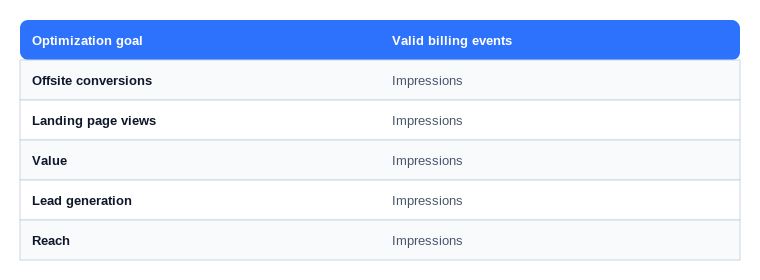
For auction campaigns with an optimization goal set, Meta restricts the billing event you can choose. These pairings come from its table, which assumes the campaign has an objective.
| Optimization goal | Valid billing events |
|---|---|
| Offsite conversions | Impressions |
| Landing page views | Impressions |
| Value | Impressions |
| Lead generation | Impressions |
| Reach | Impressions |
| Link clicks | Link clicks or impressions |
| ThruPlay | Impressions or ThruPlay |
| Two-second continuous video views | Impressions or two-second continuous video views |
The same table lists impressions as the only valid billing event for other goals, including app installs, ad recall lift, engaged users, event responses, page likes, replies and social impressions. For post engagement it lists impressions and notes that, as of version 2.11, post engagement is not an option as a billing event.
What this means in practice: if your goal is purchases through the pixel, which is offsite conversions, you are billed on impressions. You are not charged per purchase, and you do not choose otherwise. If your goal is link clicks, you can choose between paying for clicks or impressions, a choice worth understanding before you compare costs across campaigns.
How should I read cost numbers with this in mind?
Two ad sets with different billing events are not directly comparable by the price on the invoice line. A cost per thousand impressions and a cost per click answer different questions. When a report or tool compares ad sets, check these points:
- Note each ad set’s optimization goal and billing event side by side.
- Compare outcomes such as cost per result on the same attribution setting, not billing units.
- Remember that billing depends on audience size and budget, as Meta states, so a changed audience can change the cost of the same billing event.
- If you use bid caps or cost caps, read how to choose a bid strategy and the cost cap vs bid cap decision tree. Meta’s bid strategy page also warns that with a bid cap, the bid is not the cost you will see in reporting.
What does this mean for catalog ads?
Meta’s Advantage+ catalog ads guide includes a worked example: to optimise for offsite conversions, including conversions from both app events and the pixel, and be billed on impressions, you set the optimization goal to offsite conversions and the billing event to impressions. It also shows retargeting examples where the goal and billing event are link clicks. Details are in what Advantage+ catalog ads need. In both cases the valid pairs match the table above.
What should I ask a tool or agency?
If someone else creates your ad sets, ask them to show the optimization goal and billing event for each ad set. A clean answer names both and explains why that pair fits the objective. Because Meta restricts the combinations, a surprising billing event usually points back to the optimization goal, so check that first. See the Meta ads glossary for related terms.
Where does Bach.ai fit?
Bach.ai is our product. It audits Meta and Google Ads accounts, reviews budget and bidding setups and flags disapproved ads as policy blockers, but it does not change what Meta charges you for or override the billing events Meta allows, and findings are estimates, not guarantees. On a paid plan a supported change is applied only after you approve it by default. For a full review, use the Meta ads audit checklist.
FAQ
Is the billing event the same as the optimization goal?
No. The optimization goal is the outcome Meta tries to deliver, while the billing event defines what you pay for. Meta’s own example optimises for post engagement while paying per impression, and each goal restricts the billing events you may pick.
Can I pay per purchase on Meta?
Not through the auction ad set options in Meta’s table. For the offsite conversions goal, which covers purchases tracked by the pixel, the only valid billing event listed is impressions, so you pay for impressions while Meta optimises for the conversion.
When can I choose link clicks as the billing event?
When the optimization goal is link clicks, Meta’s table allows either link clicks or impressions. Other goals, such as landing page views, offsite conversions and reach, allow impressions only, so the choice exists mainly for click-based goals.
What are reserved and fixed CPM buying types?
Meta says reserved means billing is based on a prediction, and fixed CPM means the advertiser negotiates a fixed price. Most advertisers use auction. Both special types need ad sets with a billing event defined.
Sources, read on 25 November 2026: Billing events; Advantage+ catalog ads, get started; Bid strategy.