Reach vs Impressions in Meta Ads Explained
What is the difference between reach and impressions?
Reach is the number of people who saw your ad at least once; impressions count every time the ad was on screen, including repeat views by the same person. Divide impressions by reach and you get frequency. Meta says reach and frequency are calculated from sampled data.
Reach and impressions sit side by side in Ads Manager and answer different questions: how many people, and how many views. Mixing them up leads to wrong readings of cost per thousand and of ad fatigue. Everything below is taken from Meta’s help definitions, read on 25 November 2026; Meta revises metrics, so check the linked pages if a number in your account looks off.
How does Meta define reach?
Meta’s glossary defines reach as the number of people who saw your ads at least once during the campaign’s lifetime. It says reach is different from impressions, which may include multiple views of your ads by the same people. It also says reach is affected by your bid, budget and audience targeting, and that the metric is calculated using sampled data, so treat it as an estimate.
How does Meta define impressions?
Meta defines impressions as the number of times your ads were on screen. Its page says an impression is counted the first time an instance of an ad is on screen, so if someone scrolls away and back to the same ad, that is one impression. If an ad is on screen for a person at two different times in a day, that counts as two impressions.
Two details help when you compare numbers. With the exception of ads on Meta Audience Network, impressions are counted the same way for image and video ads, so a video does not have to start playing for the impression to count. And impressions from invalid traffic that Meta detects, such as bots, are not counted.
How do reach, impressions and frequency relate?
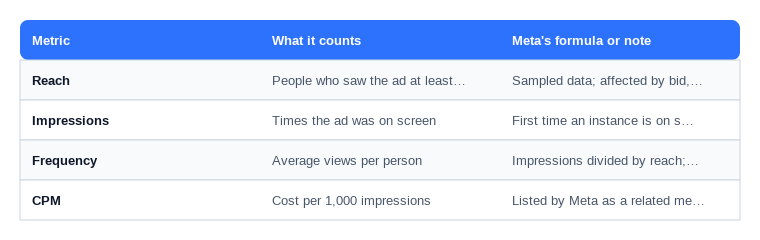
| Metric | What it counts | Meta’s formula or note |
|---|---|---|
| Reach | People who saw the ad at least once | Sampled data; affected by bid, budget and targeting |
| Impressions | Times the ad was on screen | First time an instance is on screen; scrolling back is not a second one |
| Frequency | Average views per person | Impressions divided by reach; sampled data |
| CPM | Cost per 1,000 impressions | Listed by Meta as a related metric of impressions |
Illustrative arithmetic, not a benchmark: if an ad set shows 30,000 impressions to 20,000 people, frequency is 1.5. If the same impressions reached only 6,000 people, frequency is 5, and the same spend is being shown repeatedly to a small group.
What frequency should I expect?
Meta says frequency may average 1 to 2 per ad set or may be much higher, depending on your budget, audience size and schedule. It advises monitoring frequency alongside results and ad relevance diagnostics so the same people are not seeing ads too often. If performance begins to drop as frequency rises, Meta says your audience may be experiencing ad fatigue and it may be wise to change the creative or targeting.
We do not know a universal “too high” number and do not offer one. For the practical response, read How do I fix Facebook ad frequency that’s too high?, and for the reservation-buying control see How do I set a frequency cap on Facebook ads?.
Which one should I use to judge a store campaign?
For a sales campaign, neither. Reach and impressions describe exposure, not orders. Use them to explain other numbers:
- If cost per result rises while impressions are flat, check the audience size and frequency for saturation; see How small is too small for a Meta audience?.
- If reach is high but sales are low, compare placements; Reels reach versus ROAS shows a typical case.
- If your CPM jumps, look at the audience and placements before the creative.
- If frequency rises with falling conversion rate, plan fresh creative.
- Put the final judgement on revenue and margin in your store data.
Awareness campaigns are different: there reach is the point, and Meta describes the Awareness objective as reaching the largest number of people most likely to remember your ad.
Why do my reach and impressions not match another report?
Meta says reach is calculated using sampled data, and counting rules differ between tools, so totals from Ads Manager, a third-party dashboard and your own analytics can differ. Treat small gaps as expected and large ones as something to investigate. When reports disagree on orders, start with Why do Meta and GA4 report different numbers?.
Where does Bach.ai fit?
Bach.ai is our product. Its audit flags audience saturation, meaning high-frequency audiences, and ranks findings by estimated recoverable spend; that estimate is not guaranteed savings. On a paid plan, a supported Meta change is applied only after you approve it by default (Auto-Pilot is opt-in), and the free trial does not apply changes. The Meta Ads audit checklist covers the same check by hand.
FAQ
Can impressions be lower than reach?
By definition, no. Every person counted in reach saw the ad at least once, so impressions should be at least as high as reach. Because Meta says reach uses sampled data, check the definition before treating a small oddity as a bug.
Does scrolling back to an ad count twice?
No. Meta’s example says that scrolling down and back up to the same ad on screen counts as one impression. Seeing it again at a different time counts again.
Is reach the same as unique visitors?
No. Reach counts people who saw the ad on Meta, not people who clicked or visited your site. Clicks and sessions are counted by different tools.
Why is my frequency 1.0?
Frequency is impressions divided by reach, so 1.0 means each person counted saw the ad about once. That is common for small budgets or large audiences.
Sources, read on 25 November 2026: Glossary of Reach and Frequency Terms; Impressions; Frequency; How to choose the right ad objective.