How Do I Build a Lookalike From Customer Value?
How do I build a value-based lookalike audience on Meta?
Upload a customer list with a numeric value column, such as order value or lifetime value, and tell Meta which column holds it. Then create a lookalike from that custom audience. Meta says the result is made up of people most similar to your highest-value customers, whereas a regular lookalike finds people similar to all customers.
A regular lookalike treats a one-time discount buyer and your best repeat customer alike. A value-based lookalike lets you tell Meta which customers matter more. This guide uses Meta’s pages on customer value audiences, customer lifetime value and customer list formatting, read on 25 November 2026. Meta revises these options, so confirm in Ads Manager.
What is a customer value audience?
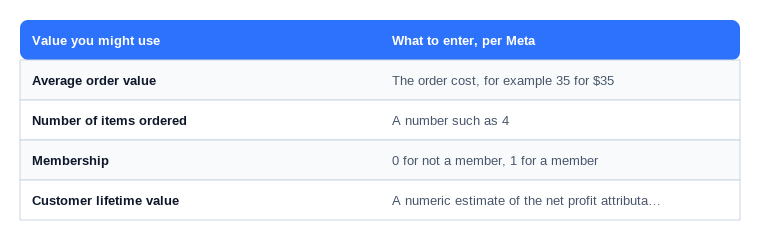
Meta says that when you create a customer list audience you are asked whether your list includes a column for customer value, a number that quantifies the customer qualities you consider most desirable. You choose what you value. With a value column you can deliver ads to valuable customers, exclude them, or create a value-based lookalike to find people similar to them. Meta’s examples of values:
| Value you might use | What to enter, per Meta |
|---|---|
| Average order value | The order cost, for example 35 for $35 |
| Number of items ordered | A number such as 4 |
| Membership | 0 for not a member, 1 for a member |
| Customer lifetime value | A numeric estimate of the net profit attributable to the customer over the relationship |
The column must list decimal or whole numbers only, with no currency characters.
How is it different from a regular lookalike?
Meta says that if you add a customer lifetime value column to a file for a custom audience, you can use it as the source for a value-based lookalike, made up of the people most similar to your highest-value customers, while a regular lookalike can only find people similar to all your customers. A Meta Pixel, SDK, catalog or mobile app can also be a source.
How do I create it?
- Go to Audiences, then Create audience, Custom audience, Customer list.
- Prepare the list by selecting identifiers, and answer the Customer value prompt.
- Add your file and name the audience.
- Select “Yes, customer value is included in my customer list” and choose the value column from the dropdown.
- Review the mapping: a green check means identifiers mapped correctly, a yellow exclamation point means something needs a fix.
- Select Import and create, then use the prompt to create a lookalike audience, or go to Audiences and choose Create audience, then Lookalike audience, and select the source.
Format the list correctly first; see How should I format a customer list for Meta?.
What should I use as the value?
Meta cautions that customer lifetime value is a prediction combining purchase frequency, spend per purchase, projected total spend and relationship length, and that you should not use any one factor alone as a stand-in; combine them into a formula suited to your goals. For a store, the simplest honest options are total revenue per customer or gross margin per customer from your own order history. Margin is better than revenue where discounts vary, since it rewards customers who are profitable. If you do not track lifetime value, Meta says you can still use custom audiences without it. Keep the formula fixed between uploads, or results will not be comparable.
Will it beat my regular lookalike?
Meta gives no promise. Test it: build one regular and one value-based lookalike from the same customers, same percentage and same location in the ad set, run the same creative for a few weeks and compare cost per purchase and revenue per order from store data. Our guide to seeds is What makes a good lookalike audience source?, and the location change is in Do I still pick a country for a lookalike audience?. Whether you should optimise delivery on value is a different setting; see Should I use value optimisation or purchase optimisation?.
What mistakes should I avoid?
Four come up often. Using revenue where discounts vary rewards customers who bought only on sale, so prefer margin if you have costs. Changing the value formula between uploads, which makes tests incomparable. Leaving currency symbols or text in the value column, which Meta does not accept. And uploading too small a list: Meta’s guidelines say at least 1,000 customers. Keep a note of the formula, the date and the number of customers in each upload. When a value-based lookalike underperforms, check the seed before blaming the audience type: a seed dominated by one campaign’s buyers teaches Meta that campaign’s audience, not your best customers in general.
Bach.ai is our product. Its Shopify connection reads orders and, where product costs are available, shows margin ROAS, which can help you pick a margin-based value; it does not upload audiences. On a paid plan a supported change is applied on Meta or Google Ads only after you approve it by default (Auto-Pilot is opt-in); the free trial does not apply changes, and recoverable-spend figures are estimates, not guarantees. For a hands-on review, use the Meta Ads audit checklist.
FAQ
Can I use currency symbols in the value column?
No. Meta says the column must contain numbers only, whole or decimal, without currency characters.
Do I need lifetime value specifically?
No. Meta lists order value, items ordered and membership as examples, and says you choose what you value.
Can an exclusions-only list be a source?
No. Meta says an exclusions-only customer list cannot be used to make a lookalike audience.
How big should the list be?
Meta’s formatting guidelines say at least 1,000 customers, and its lookalike page generally recommends a source of 1,000 to 5,000 people.
Sources, read on 25 November 2026: Create a customer value custom audience; About customer lifetime value; About the customer value column; Customer list formatting guidelines.