What Are the Instagram Stories Ad Specs?
What are the Instagram Stories ad specs?
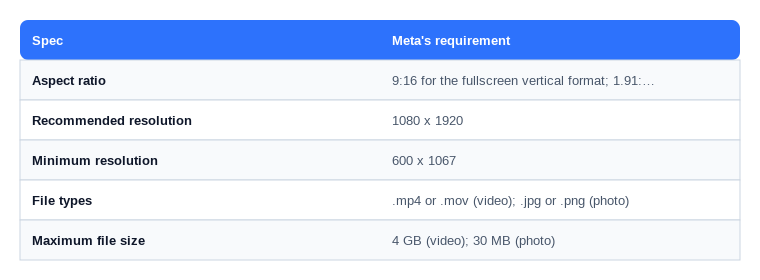
Meta recommends a 9:16 aspect ratio at 1080 x 1920, with a 600 x 1067 minimum. Accepted files are .mp4 or .mov for video and .jpg or .png for photos, up to 4 GB and 30 MB. Images display for 5 seconds by default. Stories carousels are limited to 3 cards.
Stories is a full-screen vertical placement, so a square Feed image will be cropped or letterboxed. Meta’s help center publishes the design requirements, and the details below are from those pages, read on 25 November 2026. Specs change, so check Ads Manager previews before you export a batch.
What are the core specs?
| Spec | Meta’s requirement |
|---|---|
| Aspect ratio | 9:16 for the fullscreen vertical format; 1.91:1 for Advantage+ catalog ads |
| Recommended resolution | 1080 x 1920 |
| Minimum resolution | 600 x 1067 |
| File types | .mp4 or .mov (video); .jpg or .png (photo) |
| Maximum file size | 4 GB (video); 30 MB (photo) |
| Video length | Maximum 60 minutes listed on the design page |
| Image display time | 5 seconds by default |
| Codecs | Video H.264 or VP8; audio AAC or Vorbis |
Meta also says that all feed photo and video dimensions are supported for the Stories placement, from 1.91:1 wide horizontal to 4:5 vertical. That means a Feed asset will run, but a 9:16 asset fills the screen. The placement ratio table and the general rules are in What aspect ratio should Instagram ads be?.
How long should a Stories ad be?
The 60-minute figure on Meta’s page is a technical maximum, not advice. Meta’s carousel page gives 15 seconds as the video limit for carousel cards in Instagram Stories, and a Stories carousel may have only 2 to 3 cards. For a store, keep the story short enough to show the product, the offer and the call to action inside the first few seconds. Which creative moves sales is a test question; see Instagram story ads that convert.
What about text and safe zones?
Meta recommends keeping important text and visuals inside the safe zone and reviewing auto-generated crops before publishing. Its aspect ratio page adds that on devices with screens taller than 9:16, Meta may zoom the creative to fill the screen, which can crop areas outside the safe zone, or show the original ratio on a black background.
What is the quickest way to build a Stories asset?
- Start from your best Feed video or product shot.
- Rebuild it at 1080 x 1920 in a design or video tool, keeping the product central.
- Move captions and the offer away from the very top and bottom.
- Export as .mp4 or .mov with H.264 video and AAC audio.
- Upload in Ads Manager and preview in Stories before publishing.
- Keep the Feed version as a separate asset so each placement has its own crop.
If your ad does not appear on Instagram at all, see Why aren’t my ads showing on Instagram?, and for Reels see Instagram Reels ad specs and what to test. To build a carousel instead, use How many cards can an Instagram carousel ad have?.
How do Stories ads differ from Reels and Feed ads?
Stories, Reels and Feed share the same Instagram app but not the same frame. Meta’s placement table lists 9:16 as the recommended ratio for Stories and Reels, while 1:1 is the recommendation for single-image Feed ads. A vertical asset can therefore serve both Stories and Reels, and a square asset serves Feed. That is the reason to build two masters, not one. When you compare placements in Ads Manager, break results out by placement and compare cost per purchase, not reach, because a full-screen placement often shows cheap impressions. Our guide to placement trade-offs is Advantage+ placements vs manual placements.
What mistakes cost the most time?
Four mistakes show up repeatedly in review. Exporting at 1080 x 1080 and expecting it to fill the screen leaves bars or a crop. Uploading a file above the 4 GB video or 30 MB photo limit fails at upload. Adding long text at the first frame that is read in half a second is wasted when images show for only 5 seconds by default. And using the Catalog ad ratio, 1.91:1, for a non-catalog ad is wrong, because Meta reserves that guidance for Advantage+ catalog ads. Check each against the numbers in the table above before you publish.
Bach.ai is our product. Its audit flags creative fatigue and can draft the next angle to test, but it does not produce or resize your Stories assets. On a paid plan a supported change is applied on Meta or Google Ads only after you approve it by default (Auto-Pilot is opt-in); the free trial does not apply changes, and recoverable-spend figures are estimates, not guarantees. For a hands-on review, use the Meta Ads audit checklist.
FAQ
Can I use a Feed image in Stories?
Meta says all feed photo and video dimensions are supported for Stories, from 1.91:1 to 4:5, though 9:16 is recommended for full-screen.
How long do images stay on screen?
Meta says images show for 5 seconds by default.
What file formats work?
.mp4 or .mov for video and .jpg or .png for photos, with H.264 or VP8 video and AAC or Vorbis audio.
How many cards in a Stories carousel?
Meta’s carousel page lists a minimum of 2 and a maximum of 3 cards in Instagram Stories.
Sources, read on 25 November 2026: Design requirements for Instagram Stories ads; Design specifications for carousel ads; Best practices for aspect ratios in Meta ads.