Is Google Demand Gen an Alternative to Meta Ads?
Is Google Demand Gen an alternative to Meta ads?
It overlaps for visual prospecting but is not a swap. Demand Gen serves ads on YouTube, Discover, Gmail and the Display Network, with channel controls, lookalike segments and A/B experiments. Test it with a capped budget beside Meta, compare cost per purchase on your own order data, and keep Meta running.
Many D2C brands built their prospecting on Meta and now ask whether Google’s Demand Gen can share the load. The honest answer is that it can add reach, not replace a channel you have tuned for years. Here is what Google documents and how to test it fairly.
What is Demand Gen?
Google describes Demand Gen campaigns as campaigns that capture engagement and action across YouTube, including Shorts, Discover, Gmail, Maps and the Google Display Network, aimed at social advertisers (About Demand Gen campaigns). The page also states that Google Display Ads campaigns are moving to Demand Gen: from June 2026 eligible advertisers can voluntarily migrate existing campaigns with a tool, and later new campaigns can only be created in Demand Gen with remaining eligible campaigns migrated automatically.
Controls it lists: Channel Prioritization to prioritise Google channels or the Display Network, choosing the Demand Gen channel where ads show (for example YouTube Shorts only for a vertical video), lookalike segments, audience insights, A/B experimentation, product feeds, promotion assets, and value-based and Maximize Clicks bidding.
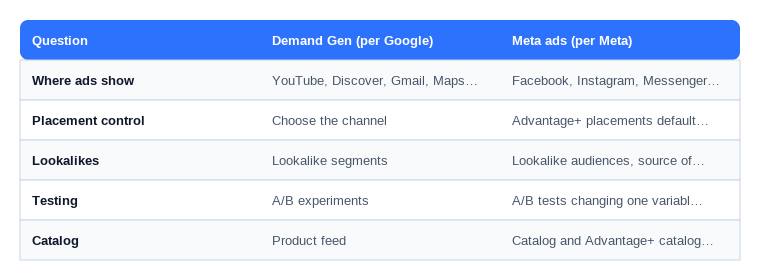
How does it compare with Meta’s tools?
| Question | Demand Gen (per Google) | Meta ads (per Meta) |
|---|---|---|
| Where ads show | YouTube, Discover, Gmail, Maps, Display Network | Facebook, Instagram, Messenger, Audience Network, with Advantage+ placements |
| Placement control | Choose the channel | Advantage+ placements default for Sales, Leads and App promotion; Awareness, Traffic, Engagement keep manual choice |
| Lookalikes | Lookalike segments | Lookalike audiences, source of at least 100 people, 1,000 to 5,000 generally recommended |
| Testing | A/B experiments | A/B tests changing one variable such as image, text, audience or placement |
| Catalog | Product feed | Catalog and Advantage+ catalog ads |
Sources for the Meta column: About Advantage+ placements, Create a lookalike audience, About A/B testing. Meta reports an experiment where ad sets using Advantage+ placements had 11.7% lower cost per action on average than manual placements; that is Meta’s figure, not ours, and it describes Meta placements only.
What is the same and what is different?
The same creative discipline applies: hooks, proof, and fresh variants. The difference is intent and context. On Meta, people scroll a social feed; on YouTube, Discover and Gmail the surface differs, and Google’s page describes pairing visuals and messages with placements using Google AI. Do not assume audiences, costs or conversion rates carry across. Use your own data.
Which creative formats should I prepare?
Google’s example is a vertical creator video served on YouTube Shorts only, which suits a mobile viewing context. If your best Meta creative is a vertical video made for Reels, you already have a starting point; see Which Meta ad format works best for D2C? for how to choose, and Which Instagram placements should my store’s ads run on? for the Meta side of placement choice. Prepare each asset at the sizes Google lists for the placement, and write text that reads without sound. Test two angles, not ten, so each gets enough data to judge.
A common failure is copying a Meta ad that relies on social proof from the platform itself, such as visible likes and comments, to a surface where those do not appear. Rebuild the proof into the creative: a review quote, a rating screenshot or a short customer clip. Do likes carry over when I turn a post into an ad? explains what travels with a Meta post and what does not.
How should I test it?
- Pick one product or offer with a clear Meta baseline.
- Cap the test at a small share of monthly spend you can afford to lose; the ad spend calculator helps size it.
- Reuse your best two or three creatives, resized for the placements.
- Use a product feed if you sell catalog items.
- Run for a fixed period with no edits mid-test.
- Compare cost per purchase and new-customer share using your store’s orders, not platform reports alone; see Why does Meta show more purchases than Shopify? for why.
- Decide: scale, repeat with changes or stop.
What can go wrong?
Splitting a small budget over two platforms starves both. Judging results on view-through credit overstates the channel; check the attribution settings in each platform and align them. Missing tracking on the Google side breaks the test; confirm conversion tracking before you spend. And do not read a Google claim about reach as a promise of results. For the broader tool picture see best Meta ads tools.
Can software help?
Bach.ai audits Meta and Google Ads accounts, ranking findings by estimated recoverable spend, and checks ad-reported revenue against store orders through a read-only Shopify connection. It does not build Demand Gen campaigns, and it does not promise that Google will beat Meta for you. It helps compare the two on one set of order data.
FAQ
Is Demand Gen replacing Display?
Google says Display Ads campaigns are moving to Demand Gen, with voluntary migration from June 2026 and later automatic migration of remaining eligible campaigns.
Do I need new creative?
You can reuse strong assets, but Google lists channel-specific formats such as vertical video for Shorts. Resize rather than reuse unchanged.
Can I use my product feed?
Yes. Google says you can use a product feed to show products in Demand Gen campaigns.
Should I cut Meta spend to fund it?
Not at first. Run a capped test beside Meta, and move spend only if your own order data supports it.
Sources: Google Ads Help, About Demand Gen campaigns; Meta Business Help Center, About Advantage+ placements, Create a lookalike audience, About A/B testing (checked 25 Nov 2026); Bach.ai capabilities from our features page.