Why Meta and Google Claim More Sales Than Shopify
Why do Meta and Google together claim more sales than Shopify?
Each platform credits itself for any order it touched inside its own attribution window, so one order can be counted twice. Add view-through credit, longer windows, modeled conversions and refunds that platforms do not subtract, and the platform total can exceed Shopify's. Use Shopify orders as the ceiling and judge channels against blended revenue.
Add the revenue Meta Ads Manager reports to the revenue Google Ads reports, and the total is often larger than Shopify’s revenue for the same dates. That is not necessarily a tracking fault. Each platform answers a different question: “which orders did my ads touch?” Shopify answers “which orders were placed?” When the same shopper saw a Meta ad and clicked a Google ad, both platforms can claim the order, and Shopify counts it once.
This guide explains the five mechanisms behind the gap, how to size each, and what to use as the decision number. For the narrower question of Meta against your store alone, read why Meta shows more purchases than Shopify.
Why can two platforms claim the same order?
Neither platform sees the other’s ads. Google Ads says it reports conversions only where there are Google Ads interactions, such as clicks, from the same account, and notes that another tool may report conversions from all Google Ads clicks across accounts or credit them to other platforms (Data discrepancies). Meta credits conversions inside its own attribution window in the same way. There is no shared ledger that removes an order from Meta once Google has claimed it, so the sum of the platforms is a sum of claims, not of orders.
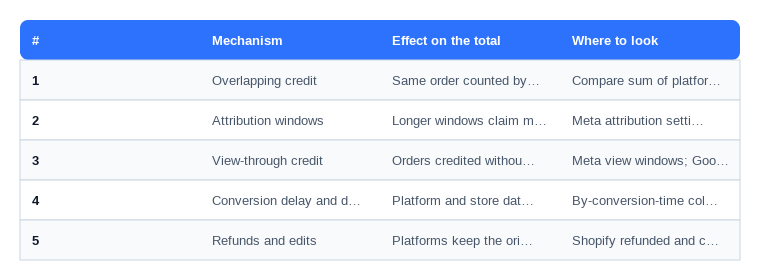
What are the five mechanisms?
| # | Mechanism | Effect on the total | Where to look |
|---|---|---|---|
| 1 | Overlapping credit | Same order counted by both platforms | Compare sum of platforms with Shopify |
| 2 | Attribution windows | Longer windows claim more orders | Meta attribution setting; Google conversion window |
| 3 | View-through credit | Orders credited without a click | Meta view windows; Google view-through column |
| 4 | Conversion delay and dates | Platform and store dates differ | By-conversion-time columns |
| 5 | Refunds and edits | Platforms keep the original value | Shopify refunded and current totals |
Windows. Meta’s Insights API lets you choose the attribution window for actions, with options including 1-day click, 7-day click, 28-day click and 1-day view, and a default that follows the advertiser’s attribution settings (Marketing API, Ad campaign insights). Meta also announced it stopped returning the 7-day view and 28-day view windows from 12 January 2026 (Meta for Developers). If your reports were saved before that date, check the window you are comparing.
View-through. Google says view-through conversions, where someone sees but does not interact with your ad and later converts, are not included in the default Conversions column, and you can add them separately. Whether to include them in a comparison is your decision, but it changes the totals.
Dates. Google Ads reports conversions on the ad impression date, whereas other tools use the conversion date. Add the by-conversion-time columns to align them (Data discrepancies).
Refunds. Shopify’s Admin API keeps an order’s original total and its current total as separate fields, and a refunded total as another (Order object). Platform revenue is built from the purchase value your tag reported at the time of sale, so check whether your setup subtracts later refunds. See how returns and refunds change true ROAS.
How do you reconcile it in one sheet?
- Export Shopify net sales by day for the month, after refunds.
- Export Meta purchases and purchase value for the same dates, with the attribution window written in the column header.
- Export Google Ads conversions and conversion value, using by-conversion-time columns.
- Add a column for the sum of the two platforms and one for Shopify.
- Compute the overclaim: (Meta + Google) minus Shopify, as a percent of Shopify.
- Repeat weekly. A stable overclaim is overlap. A growing one points to a window or tag change.
Illustrative only: if Meta claims $50,000, Google claims $30,000 and Shopify recorded $64,000, the platforms overclaim by $16,000, or 25% of store revenue. That is a prompt to use blended numbers, not proof that either platform is wrong.
What should you use as the decision number?
Use store revenue as the ceiling and spend as the denominator: blended ROAS, or MER, equals Shopify net sales divided by total ad spend. It cannot double count, because it starts from orders that exist. Platform ROAS stays useful for comparing campaigns inside that platform. Why the two diverge is covered in MER vs platform ROAS.
Then test the claim directly. Pause one channel on a small, controlled slice and watch whether store revenue falls by what the platform claimed; a simple scale-down incrementality test shows how.
Can Bach.ai do this reconciliation?
From Starter, Bach.ai connects Shopify read-only and compares the revenue Meta and Google Ads report with real store orders, so the overclaim appears as a number instead of a spreadsheet. It does not change your store, and a comparison with missing or stale inputs is shown as inconclusive rather than as zero. Details are on the Meta ads audit checklist and the pricing page.
What to do next
Build the sheet for last month, record the overclaim, and set your budget decisions against blended ROAS from now on. A free 7-day Bach.ai trial needs no card; Google Ads and Shopify connections are included in the 7-day trial and from Starter (pricing).
FAQ
Is it normal for platforms to total more than Shopify?
Yes. Each credits itself for orders it touched inside its own window, so overlap is expected. The size of the gap matters more than its existence. Compare the combined platform total with Shopify’s order count each week, and watch whether that ratio stays steady rather than reacting to a single day.
Which platform is right?
Neither is a ledger of orders. Shopify records the orders; the platforms estimate their contribution. Use Shopify as the ceiling. If the platforms together report more orders than Shopify recorded, the difference is overlap, not extra sales you can bank.
Should I shorten attribution windows to close the gap?
Shortening windows reduces overlap but also hides slower conversions. Change windows only to compare like with like, and keep the same setting over time. Shortening a window will not make the platforms agree with Shopify; it only changes which orders each one claims.
Does a bigger gap mean tracking is broken?
Not by itself. A gap that jumps after a change to tags, windows or consent settings does warrant a tracking check. Compare the gap before and after the change, and review the tags, windows and consent settings you touched.
Sources
Checked 24 Nov 2026: Data discrepancies: Factors and troubleshooting; Marketing API, Ad campaign insights; Ads Insights API Metric Availability Updates; Shopify Admin GraphQL, Order object.